
5 min read
Ultimate Checklist for HVAC Brochure Design
Master HVAC brochure design with this ultimate checklist covering layouts, content, and multi-channel strategies that convert.
Read more
April 21, 2026
Webflow e-commerce solutions give businesses a powerful way to build, design, and launch fully custom online stores — without writing a single line of code.
Here is a quick look at what these solutions offer:
The global e-commerce market reached $6.56 trillion in 2025 and is on track to hit $8.09 trillion by 2028. For home service businesses and distributors, that represents a massive opportunity — whether you are selling air filters, maintenance agreements, or product bundles directly from your website.
Traditional platforms often force you to choose between a beautiful design and a functional store. Webflow eliminates that tradeoff by combining a professional-grade visual builder with robust commerce infrastructure, all in one place.
I'm Jennifer Bagley, CEO of CI Web Group, and I have spent my career helping home service companies and contractors build digital systems that actually drive revenue — including leveraging Webflow e-commerce solutions to turn their websites into high-performing sales engines. In the sections below, we will walk you through everything you need to know to build, launch, and grow a Webflow store that works as hard as you do.
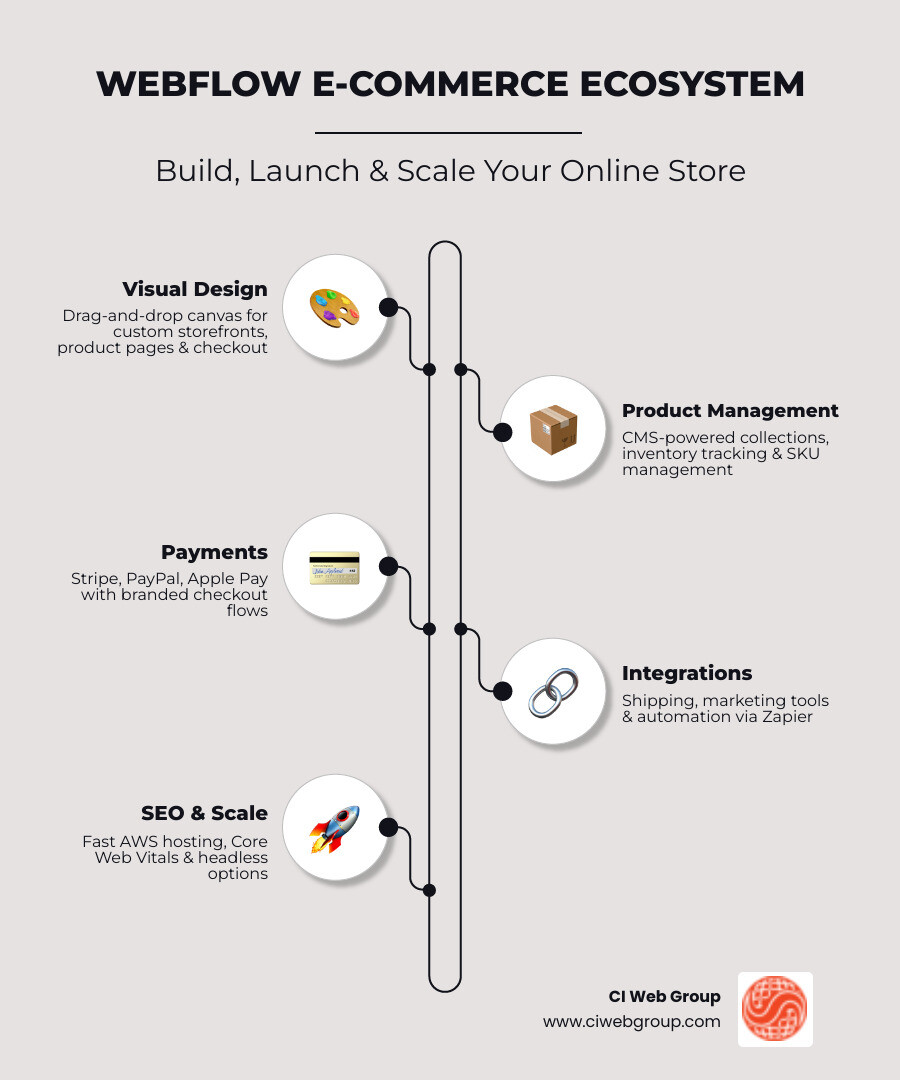
Key Webflow e-commerce solutions vocabulary:
When we talk about building an "online empire," we aren't just talking about a page with a "Buy" button. We are talking about a comprehensive digital ecosystem. Webflow provides a professional-grade toolkit that allows us to build stores that look like high-end boutique experiences but function with the reliability of a global enterprise.
The heart of the platform lies in its E-commerce Collections. Unlike other platforms that lock you into rigid templates, Webflow allows us to build a custom database for your products. This means if you are an HVAC company selling air filters, we can create custom fields for MERV ratings, dimensions, and compatible furnace brands. This level of Webflow Content Management ensures that your customers find exactly what they need without the guesswork.
Beyond the database, the visual canvas gives us total control over the cart and checkout pages. In the past, many platforms forced you to use a generic, unbranded checkout page that felt disconnected from your site. With Webflow, we can brand the entire journey, ensuring that the trust you’ve built on your homepage carries all the way through to the final "Thank You" message.
Managing a catalog shouldn't feel like a full-time IT job. Webflow’s product panel is designed for efficiency. Whether you are selling physical equipment, digital maintenance guides, or service-based packages, the interface remains intuitive.
Key management features include:
The "customer journey" is a fancy way of saying "how a person feels while buying from you." We want them to feel confident and informed. Webflow allows us to create custom add-to-cart interactions that provide immediate visual feedback—perhaps a subtle animation or a slide-out drawer that shows their current total.
Branding doesn't stop at the website. Every transactional email—order confirmations, shipping updates, and refund notices—can be fully customized. Instead of a robotic, plain-text email, your customers receive a beautifully designed message that reinforces your brand’s professionalism. This holistic approach to Webflow Web Design is what separates a "website" from a true "online store."
In April 2026, site speed is no longer a luxury; it is a requirement for survival. Google’s algorithms have become incredibly sophisticated at rewarding sites that provide a fast, stable user experience. Webflow sites are famous for achieving PageSpeed scores of 97+ on desktop and 91+ on mobile without needing a dozen different optimization plugins.
By utilizing AWS (Amazon Web Services) hosting, Webflow ensures that your store stays online even during traffic spikes. The code generated by Webflow’s visual designer is clean and semantic, which is a major factor in Webflow Speed Optimization. There is no "bloat" slowing down the browser, meaning your product images and descriptions snap into view instantly.
Having a beautiful store is pointless if nobody can find it. This is where Webflow Technical SEO comes into play. Webflow automates many of the tedious parts of SEO, such as generating sitemaps and clean URLs.
We can also set up dynamic meta tags. This means that every time you add a new product to your collection, Webflow automatically pulls the product name and description to create the SEO title and meta description. Furthermore, we can manually embed schema markup (JSON-LD) to ensure that search engines understand your pricing, availability, and reviews, often resulting in "rich snippets" that stand out in search results.
Mobile commerce hit $2.51 trillion in 2025, and that number is only climbing. Your customers are likely browsing for home services or parts while standing in their mechanical room or sitting on their couch.
Webflow’s responsive design tools allow us to build touch-friendly interfaces. We ensure that buttons are easy to tap, images are scaled correctly for small screens, and the checkout process is streamlined for one-handed use. A fast-loading mobile store isn't just about convenience—it's about preventing "cart abandonment" caused by frustration.
While Webflow is powerful on its own, it plays very well with others. Through Zapier and native integrations, we can connect your store to the tools you already use to run your business. From syncing sales data with your CRM to triggering automated marketing campaigns, the possibilities are endless. This is especially useful for AI-Powered Website Personalization with Webflow, where we can show different products to users based on their past behavior or location.
For larger businesses that need the absolute maximum in flexibility, we often recommend a "headless" approach. Headless commerce separates the "head" (the beautiful Webflow frontend your customers see) from the "body" (the heavy-duty commerce engine in the back, like Shopify).
Tools like Shopyflow allow us to use Webflow’s design freedom while leveraging Shopify’s massive app ecosystem and enterprise-grade checkout.
| Feature | Native Webflow Architecture | Headless Integration (e.g., Shopyflow) |
|---|---|---|
| Design Control | 100% Visual Freedom | 100% Visual Freedom |
| Backend Engine | Webflow Native | Shopify / BigCommerce |
| Inventory Limit | Up to 15,000 items | Unlimited |
| App Ecosystem | Growing / Zapier-based | 8,000+ Native Apps |
| Checkout Control | High | Extreme (via Headless APIs) |
To truly scale, you need to automate the boring stuff. We help our clients integrate with specialized tools:
For our clients in the HVAC, plumbing, and electrical trades, Webflow e-commerce solutions are a game-changer. You aren't just selling "stuff"; you are selling convenience and peace of mind.
Imagine a customer in Houston or the Pacific Northwest noticing their air filter is dirty. Instead of driving to a big-box store, they go to your website, find their specific filter size, and sign up for a recurring subscription. You get recurring revenue, and they get a clean filter delivered to their door every three months.
We also use these tools to sell:
You can sell almost anything. This includes physical goods (like thermostats, filters, or water softeners), digital downloads (like DIY maintenance eBooks or system manuals), and professional services (like a flat-rate "Winterization Special"). You can even set up subscription-based maintenance plans to build predictable monthly recurring revenue.
Webflow takes security seriously. All sites come with SSL certification, and the e-commerce engine is PCI compliant. Payments are processed through industry leaders like Stripe and PayPal, which support Apple Pay and Google Pay. This ensures that your customers' sensitive data is never stored on your actual site, reducing your liability and increasing their trust.
Yes, but the approach changes as you grow. For stores with a few hundred or a few thousand products, Webflow’s native architecture is fantastic. For "online empires" with tens of thousands of SKUs and complex global logistics, we typically implement a headless commerce solution. This gives you the best of both worlds: Webflow's world-class design and a specialized enterprise backend.
Building a successful online store in 2026 requires more than just a template; it requires a strategic blend of design, speed, and automation. At CI Web Group, we specialize in creating data-driven digital marketing systems for home service companies. Our goal is to help you dominate online search and turn your website into a 24/7 sales machine.
By leveraging Webflow e-commerce solutions, we provide our clients with complete asset ownership, total transparency, and a store that is built to scale. Whether you are looking to sell air filters in Houston or maintenance plans across the Southeast, we have the expertise to make it happen.
Are you ready to stop managing a "website" and start building an "online empire"? Build your high-performance store today with the team that knows the trades better than anyone else.
Search our Blog
5 min read
Ultimate Checklist for HVAC Brochure Design
Master HVAC brochure design with this ultimate checklist covering layouts, content, and multi-channel strategies that convert.
Read more

5 min read
Beginner's Guide to Starting an Advertising Agency Online
Learn how to start an advertising agency online with this beginner's guide covering niche selection, tech stack, AI tools, client acquisition, and more.
Read more

5 min read
The Complete Guide to Plumbing Website Design
Discover expert plumbing website design strategies that boost conversions, mobile performance, and local SEO for your plumbing business.
Read more

5 min read
5 Ways to Find a Reliable Plumber Fast
Discover plumbing website content strategies that help homeowners find a reliable plumber fast with mobile-friendly design and trust signals.
Read more