
5 min read
The Definitive Guide to HVAC Vehicle Wraps
Discover how HVAC vehicle wraps boost brand visibility, generate leads, and build trust with professional fleet graphics that deliver lasting marketing results.
Read more

June 3, 2026
Plumbing website content is the first thing a stressed homeowner sees when a pipe bursts at 2 AM and they grab their phone. Before they read a single word, they've already made a snap judgment — does this website look trustworthy? Is there a phone number I can tap right now? Can this company actually help me?
Here's what effective plumbing website content needs to include, at a glance:
The stakes are high. According to industry research, 70% of people check a plumbing company's website before making a call — and 40% will abandon a page that takes more than 3 seconds to load. A website that looks good but buries the phone number or loads slowly on mobile will lose those leads to a competitor whose site simply works better under pressure.
Most plumbing websites are built to look professional. Fewer are built to actually convert a panicked homeowner into a booked job. That gap — between looking good and performing well — is exactly what this guide addresses.
I'm Jennifer Bagley, CEO of CI Web Group, and I've spent my career helping home service contractors close that gap by building plumbing website content systems that are aligned with how customers actually search, decide, and call. In the sections ahead, I'll walk you through the five website signals homeowners use to decide which plumber to trust — and how to make sure yours sends the right message every time.
Similar topics to plumbing website content:
When water is pooling on the bathroom floor, nobody has time to read a 10-page history of a plumbing company. Stressed customers make a decision in roughly 0.05 seconds of landing on a webpage. They are looking for visual and structural cues that signal safety, speed, and competence.
For plumbing business owners, this means your customer journey must be friction-free. If a visitor has to dig through a cluttered menu to find out if you serve Houston, Texas, or if you handle slab leaks, they will hit the back button.
To help you understand how high-converting websites differ from those that struggle to generate leads, we have broken down the structural differences below:
| High-Converting Website Elements | Low-Converting Website Elements |
|---|---|
| Click-to-call phone number sticky header | Hidden phone number only in the footer |
| Real photos of local technicians and branded trucks | Generic stock photos of models pretending to hold wrenches |
| Fast mobile load time (under 2 seconds) | Heavy, uncompressed background videos that lag on mobile |
| Dedicated pages for every specific service offered | A single "Services" page with a bulleted list of 20 items |
| Live-streamed Google Reviews near call-to-action buttons | Self-written, unverified testimonials with no dates |
| Local service area pages mentioning real neighborhoods | Vague "serving the entire region" statements |
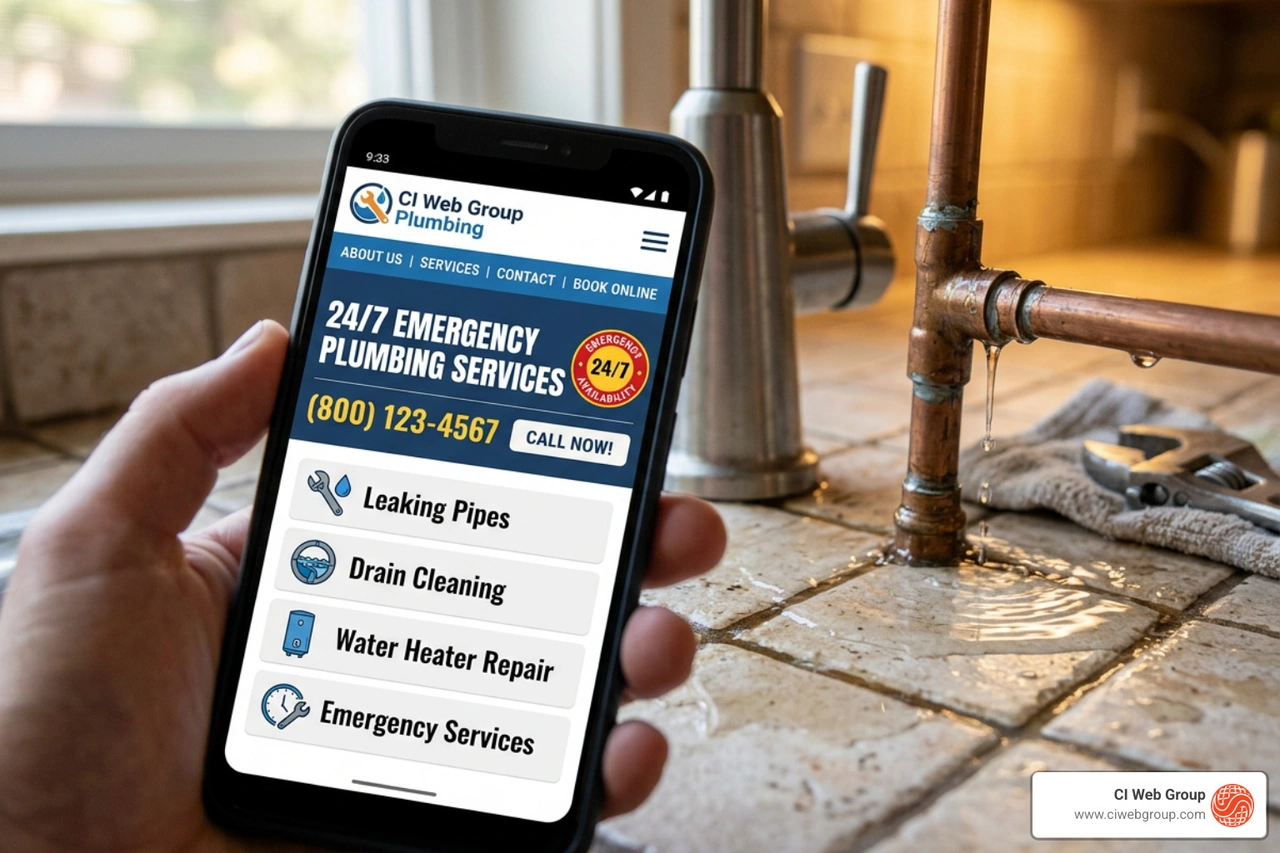
Over 63% of local searches are performed on mobile devices, and for emergency plumbing, that number often climbs past 80%. When a homeowner is standing in a flooded kitchen, they are not using a desktop computer; they are holding a smartphone in one hand and a mop in the other.
Mobile-first design is not just a technical recommendation — it is a direct driver of revenue. An effective mobile layout positions the most critical action item, the phone number, in a sticky header that remains anchored to the top of the screen as the user scrolls.
This button must be configured as a direct click-to-call link. If a user has to copy, paste, or memorize a phone number to dial it, you have introduced a point of friction that could cost you the lead.
Additionally, navigation menus must be simplified for touch screens. Large, thumb-friendly buttons prevent accidental clicks and make it easy to navigate to key pages. For a complete blueprint on structuring these features, explore our Plumbing Company Website Guide.
Trust is the primary currency of the home services industry. Inviting a stranger into a home, especially during an after-hours emergency, requires a high level of reassurance.
Many plumbing websites rely heavily on generic stock photos of smiling models. However, modern consumers are highly adept at spotting stock imagery, which can make a business feel distant or impersonal. In fact, home service websites that feature authentic photos of their real team, branded trucks, and local office receive significantly more engagement.
Beyond real imagery, your plumbing website content must display clear trust signals above the fold:
When a customer sees your real face and verifiable credentials, they feel confident that a professional, accountable technician will arrive at their door. Learn more about developing an authentic local brand in our guide to Plumbing Branding.
A common mistake in home services marketing is grouping all offerings onto a single, generic "Services" page. While this might seem organized, it fails to satisfy both search engine algorithms and user search intent.
When a homeowner experiences a backed-up sewer line, they do not search for a general "plumber." They search for "sewer line repair" or "drain cleaning." If your website only has a single page with a bulleted list of services, search engines will struggle to rank your site for those highly specific, high-intent search terms.
Every core service you offer deserves its own dedicated page. A high-performing service page should be structured to guide the reader through a logical decision-making process:
By expanding your service offerings into individual, content-rich pages, you build deep topical authority that search engines reward. To master this structural layout, read our comprehensive Plumbing SEO Complete Guide.
If you operate in competitive metropolitan areas — whether in Houston, Texas, across the Pacific Northwest, the Southeast, or the Southwest — you need to prove to search engines and local residents that you actually work in their specific neighborhoods.
This is accomplished through dedicated service area pages. Instead of simply listing 30 zip codes in your footer, you should create individual pages for the primary cities and suburbs you serve.
However, search engines penalize duplicate content. You cannot simply copy and paste the same text and swap out the city names. Each service area page must contain unique, localized details:
By tailoring your content to specific suburbs, you signal to local searchers that your trucks are already nearby and ready to respond.
Social proof is often the final factor that converts a website visitor into a booked appointment. Over 90% of consumers state that online reviews influence their purchasing decisions.
To maximize the impact of your reviews, do not relegate them to a single, isolated "Testimonials" page. Instead, integrate real-time review feeds directly onto your homepage and service pages. Seeing a fresh, five-star review about "water heater repair" directly next to your water heater booking form drastically reduces conversion hesitation.
Additionally, integrating a structured Frequently Asked Questions (FAQ) section on your service pages serves a dual purpose:
By addressing customer questions transparently and showcasing verified local feedback, you build a reliable lead-generation asset. For advanced strategies on turning web traffic into repeat customers, check out our Plumbing Lead Generation Ultimate Guide.
A great website is more than just an online business card; it is an active sales system. When your plumbing website content is structured correctly, it guides visitors naturally from initial panic to a booked service call.
To achieve this, the layout must balance clean visual design with strong Expertise, Experience, Authoritativeness, and Trustworthiness (E-E-A-T) signals. When a visitor lands on your site, they should immediately understand who you are, what geographic areas you cover, and how to take the next step.
Working with a specialized Plumbing Contractor Digital Marketing Agency allows you to implement these conversion-focused designs without sacrificing your brand's unique personality.
Emergency plumbing leads are highly valuable, but they are also incredibly time-sensitive. If a homeowner has a burst pipe, they will not wait for a contact form response. They need to speak to a human being immediately.
To capture these high-intent leads, your emergency content must convey immediate availability and reassurance:
By optimizing your layout specifically for these urgent situations, you can significantly increase your inbound call volume. To learn more about capturing high-value emergency opportunities, explore our guide on Plumbing Service Leads.
For non-emergency services, such as planned bathroom remodels, water filtration installations, or routine maintenance, the customer's buying cycle is longer. These clients are looking for an authority they can trust for the long haul.
To appeal to these researchers, your content strategy should focus on education and authority:
By providing genuine value before asking for a sale, you establish your business as a trusted local resource. For a deeper look into building a long-term content strategy, consult our Plumber Digital Marketing Complete Guide.
Answering common questions directly on your website reduces customer hesitation and streamlines the booking process. Here are some of the most common questions homeowners ask when searching for plumbing services online, along with how you can address them using Plumbing Business Solutions.
A reliable plumbing company should always make its licensing credentials easy to find. Look for active state license numbers displayed clearly in the website's header, footer, or "About Us" page. You can verify these numbers through your state's licensing board database. Professional websites will also display trust badges from organizations like the BBB or local trade associations to verify their credentials.
Slow load times are usually caused by technical issues like uncompressed high-resolution images, heavy background videos, or unnecessary backend code. Because search engines prioritize user experience, slow-loading websites are often penalized in search rankings. Compressing images into modern formats like WebP and minimizing background scripts can help ensure your site loads in under two seconds on mobile devices.
A complete, professional contact page should include multiple ways to get in touch. Look for a clickable phone number, a short and simple contact form, clear business hours, and a physical office address. An embedded Google Map of the office location is also a great trust signal, as it confirms the business has a real, physical presence in your community.
Your plumbing website is the digital front door of your business. It works 24/7 to turn stressed searchers into long-term clients. By prioritizing mobile responsiveness, authentic team photos, detailed service pages, and clear trust signals, you can build an online presence that consistently generates high-value leads.
At CI Web Group, we specialize in helping home service companies dominate local search and achieve their growth goals. We offer a unique, partner-focused model designed to protect your business:
Ready to transform your online presence and build a website that works as hard as your technicians?
Schedule a consultation for high-converting plumbing website design today, and let's build a digital marketing system that drives lasting growth for your business.
Search our Blog
5 min read
5 Ways to Find a Reliable Plumber Fast
Discover plumbing website content strategies that help homeowners find a reliable plumber fast with mobile-friendly design and trust signals.
Read more
5 min read
The Definitive Guide to HVAC Vehicle Wraps
Discover how HVAC vehicle wraps boost brand visibility, generate leads, and build trust with professional fleet graphics that deliver lasting marketing results.
Read more

5 min read
Step-by-Step Guide to Reliable Pest Control Marketing
Discover how pest control marketing services can boost local visibility, generate leads, and drive recurring revenue with proven strategies for 2026.
Read more

5 min read
The Ultimate Guide to Digital Advertising in HubSpot
Master digital advertising HubSpot strategies to boost lead quality and ROI across Meta, Google Ads, LinkedIn, and TikTok.
Read more