
5 min read
The Ultimate Guide to Digital Advertising in HubSpot
Master digital advertising HubSpot strategies to boost lead quality and ROI across Meta, Google Ads, LinkedIn, and TikTok.
Read more

May 29, 2026
Pest control marketing services are specialized digital marketing solutions designed to help pest control companies generate more leads, book more jobs, and grow recurring revenue — using channels like local SEO, Google Maps, paid ads, reputation management, and AI-powered automation.
Here is a quick breakdown of what effective pest control marketing services cover:
Running a pest control business is demanding enough without also trying to manage a fragmented marketing strategy. When a homeowner spots termites at 2 a.m. or hears something scratching in the attic, they are not browsing casually — they are searching with urgency, and they are going to call whoever shows up first and looks trustworthy. That moment is where pest control marketing either works or fails you.
The challenge is that most pest control companies are either using general marketing agencies that don't understand the industry's seasonality, local urgency, and trust dynamics — or they are trying to piece together tactics on their own without a clear system. The result is wasted budget, inconsistent lead flow, and no clear picture of what is actually driving revenue.
What separates pest control companies that grow predictably from those that stay stuck is not just more advertising spend. It is having the right marketing system — one that covers every touchpoint from the first search to the booked job, and that compounds in value over time.
The good news is that pest control is a high-demand, recurring-revenue business. Clients come back. Routes get denser. Referrals happen naturally. The right marketing system amplifies all of that.
I'm Jennifer Bagley, CEO of CI Web Group and a digital marketing strategist with deep experience helping home service companies — including pest control operators — build marketing systems that drive measurable, sustainable revenue through the right pest control marketing services. This guide walks you through everything you need to evaluate, build, and optimize a marketing strategy that actually works for your business.
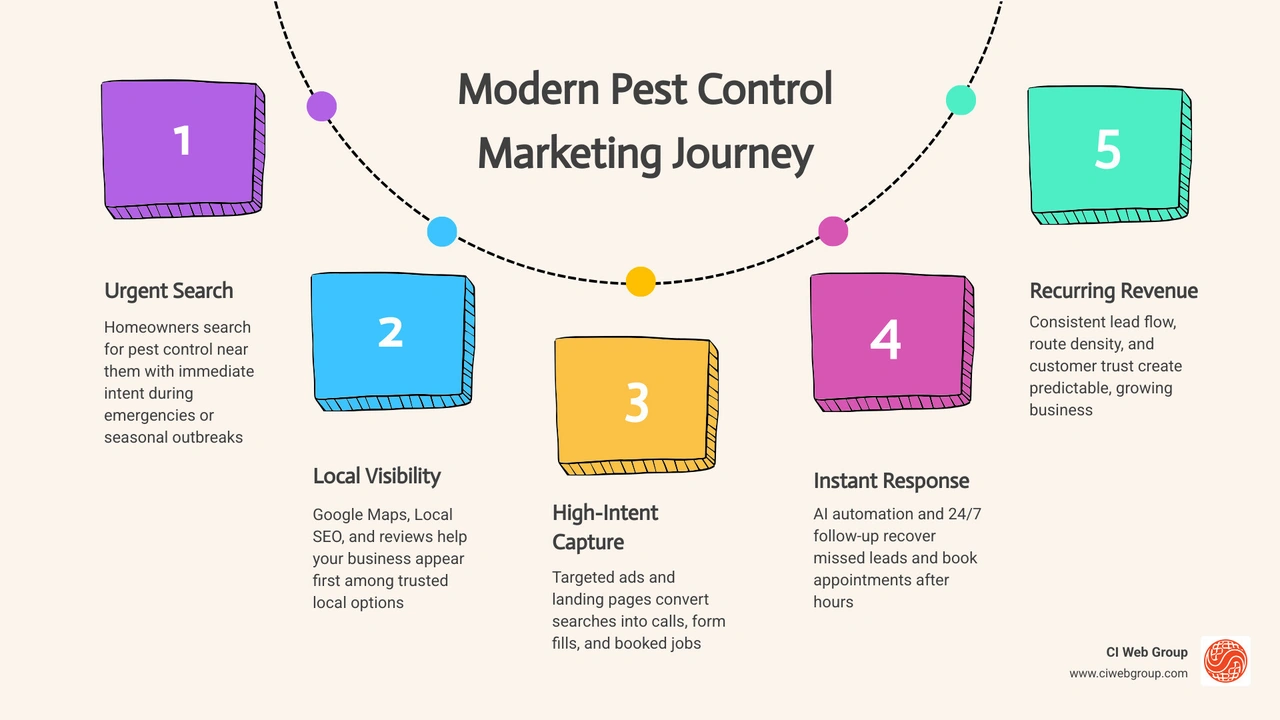
Pest control marketing services basics:
In 2026, effective pest control marketing services should work like a connected system, not a pile of random tactics. If your SEO team does not talk to your ad team, your website is slow, your reviews are stale, and your calls are not tracked, you do not have a marketing engine. You have a leak.
A reliable system should include local SEO, Google Business Profile optimization, Google Maps visibility, Local Services Ads, PPC, conversion-focused website design, review generation, AI-assisted follow-up, branding, and reporting. Our Pest Control Online Marketing Guide goes deeper into how these pieces fit together.
At minimum, pest control companies need:
This matters because pest control buyers are local, urgent, and trust-driven. They are not reading a novel. They are checking whether you serve their neighborhood, whether other homeowners trust you, and whether you look like someone who will actually answer the phone.
The most effective channels are usually the ones that capture high intent first:
Search ads and maps tend to drive the fastest lead flow because they reach homeowners already looking for help. Local SEO supports long-term visibility. Retargeting helps bring back people who visited but did not book. Email and SMS nurture are especially useful for turning one-time jobs into recurring treatment plans.
Pest control is not flat year-round. Termite demand, mosquito demand, rodent spikes, and weather-driven pest movement all affect search behavior. Marketing should adapt to that.
A smart strategy adjusts:
Urgent services need immediate visibility and immediate response. Seasonal services need proactive campaigns before demand peaks. Recurring services need nurture and retention. Different pests, different timing, different psychology.
Before you commit to any marketing program, evaluate whether it is built for business outcomes or just activity reports dressed up in nice charts.
We believe a strong marketing partner should offer:
That last part matters more than people think. If you feel trapped to stay, that is usually not a great sign.
Specialized support understands the details that make pest control different:
General marketing support often focuses on impressions, clicks, and broad traffic growth. Specialized pest control marketing focuses on booked jobs, route density, recurring revenue, and local visibility in the neighborhoods that matter most.
Watch out for these warning signs:
If someone cannot explain how a lead moves from click to booked job, that is a problem.
Ask direct questions such as:
These questions separate polished presentations from actual operational marketing.
Marketing should be measurable all the way to revenue. If it is not, you are guessing. And guessing is expensive.
A practical measurement model tracks attribution from first touch to booked call to completed job to repeat customer. Our Pest Control Marketing Budget Guide can help you think through this more strategically.
Weekly metrics should include:
These metrics tell a much more honest story than traffic alone.
The best pest control operators do not stop at lead count. They connect marketing to actual business outcomes:
Research in this space shows strong outcomes are possible when campaigns are aligned with revenue goals, including examples of 15x return on total investment, 61% increases in recurring revenue, 31% overall revenue increases, 15% revenue growth, 18% year-over-year revenue growth, and even 4x lead growth. Those numbers are not a promise, but they do show what becomes possible when marketing is measured properly and optimized around profitable work rather than vanity wins.
Impressions, reach, and even traffic spikes can look exciting. They can also be completely useless.
A campaign can generate:
This is why we focus on lead quality, response speed, conversion rate, and revenue impact. A thousand extra visitors do not help if they are window shopping while your real leads go to voicemail.
If pest control marketing had a hometown hero, it would be local SEO. Most homeowners search for help nearby, and they often choose from the map pack before they ever scroll.
That is why Google Business Profile, local pages, citations, reviews, and technical website signals matter so much. For more depth, see our Pest Control Reputation Management Guide and Pest Control Customer Reviews.
To improve local visibility, we recommend focusing on:
This is especially important because geographic targeting in Google Ads is not perfectly accurate. Research suggests it can be only 50% to 70% accurate, which makes strong local organic visibility even more valuable.
Reviews do two jobs at once:
A strong reputation strategy includes:
Star rating, review volume, and review freshness all matter. A company with dozens of recent, detailed reviews usually looks safer than one with a handful of old ones. In pest control, trust is not optional. Nobody wants to hand over their attic, crawlspace, or kitchen to a business that feels sketchy.
Your website is not just a digital brochure. It is your conversion hub.
A strong pest control website should be:
Explore our Pest Control Web Design Services and Pest Control Web Design Best Practices 2025 for more guidance.
AI and automation are no longer extras. In 2026, they are practical tools for capturing leads faster, following up better, and reducing waste.
That includes AI chat, 24/7 booking assistance, lead routing, review automation, ad optimization, and support for answer engine optimization, AEO, and GEO. Our Lead Generation for Pest Control Businesses with AI breaks this down further.
The biggest gains usually come from:
Research also points to AI-powered systems that continuously refine campaigns and improve lead handling. That matters in pest control because lead speed is often the difference between winning and losing the job.
Useful automations include:
When used well, these workflows reduce drop-off and create a better customer experience. They also make it easier to maintain consistency when your team is busy handling actual pest problems instead of chasing every incoming lead manually.
Automation should support your team, not replace your credibility.
The best balance looks like this:
People may be happy to text for an appointment, but when they are worried about termites, rodents, or recurring infestations, they still want confidence that a real expert is behind the process.
The best marketing systems get stronger over time. They do not just generate a burst of leads and disappear. They build authority, improve conversion rates, strengthen brand recognition, and make future campaigns more efficient.
That is where content, inbound strategy, paid search, local SEO, branding, and weekly optimization all work together. To build that flywheel, start with our Pest Control Content Marketing Guide, Pest Control Inbound Marketing Guide, and Pest Control PPC Management.
A practical 90-day rollout often looks like this:
This sequence helps create both short-term lead flow and long-term visibility.
Over time, a mature pest control marketing system should produce:
That is the real goal. Not just more clicks. More control.
If you are ready to build a system that is transparent, customized, and designed to support long-term growth, we can help. At CI Web Group, we focus on data-driven marketing for home service companies with no contracts, full transparency, asset ownership, 24/7 support, and programs built around your actual goals.
If you want to strengthen your brand foundation along with your lead generation engine, explore More info about branding services.
Reliable pest control marketing services are not about doing everything at once. They are about doing the right things in the right order, measuring what matters, and improving every week. That is how lead flow gets steadier, routes get tighter, and revenue grows without guesswork.
Search our Blog
5 min read
Step-by-Step Guide to Reliable Pest Control Marketing
Discover how pest control marketing services can boost local visibility, generate leads, and drive recurring revenue with proven strategies for 2026.
Read more
5 min read
The Ultimate Guide to Digital Advertising in HubSpot
Master digital advertising HubSpot strategies to boost lead quality and ROI across Meta, Google Ads, LinkedIn, and TikTok.
Read more

5 min read
I'm looking to upgrade my plumbing fixtures. Who provides reliable plumber branding in your area?
Discover how plumber branding builds trust and recognition to help homeowners choose your services first.
Read more

5 min read
In Depth Guide to Plumbing Marketing Strategies
Discover proven plumbing marketing tips that boost local leads, improve visibility, and turn homeowner searches into booked jobs.
Read more