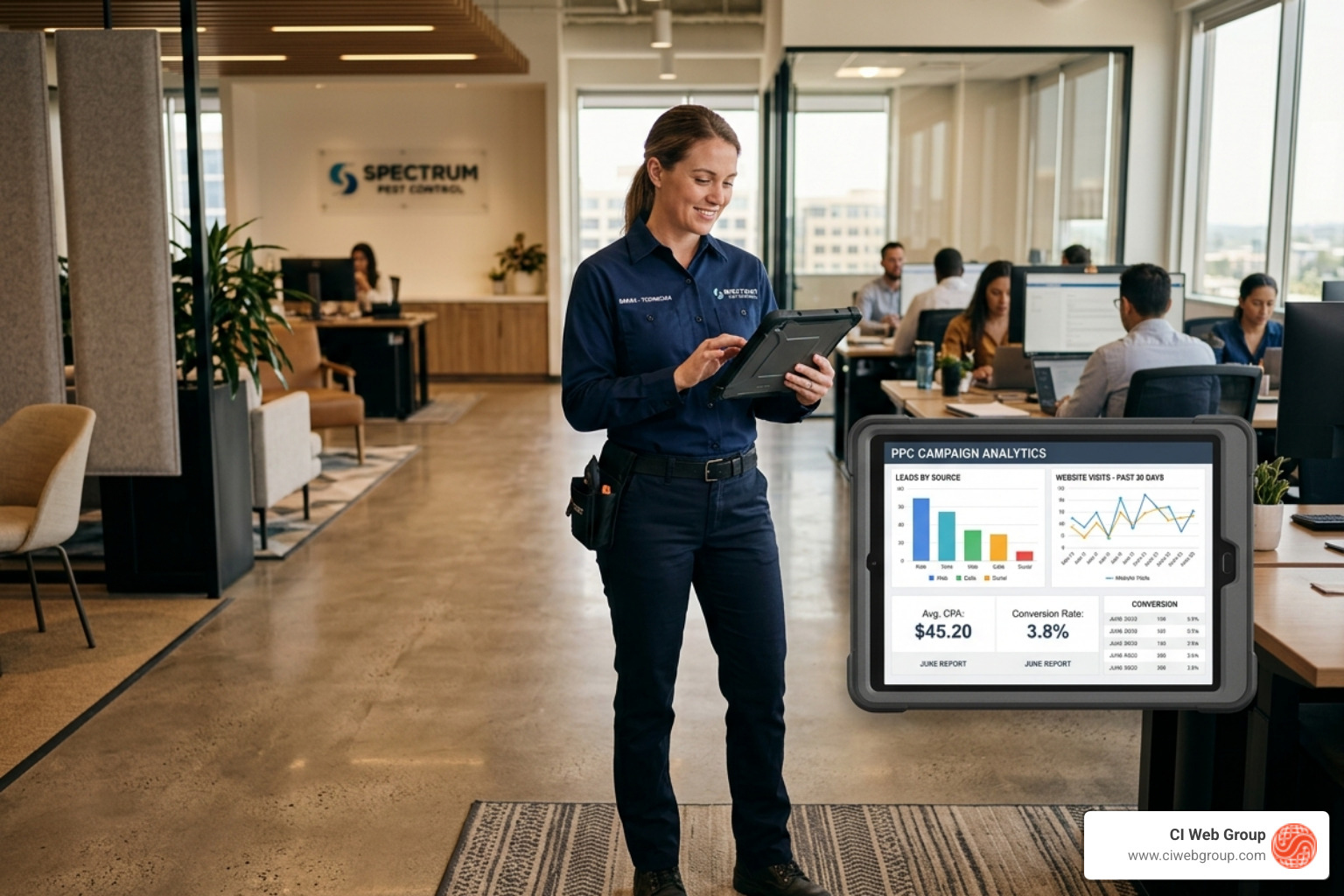
5 min read
The Ultimate Guide to Pest Control Online Marketing
Master pest control online marketing in 2026: SEO, AI, local ads & lead gen strategies for explosive growth.
Read more

March 27, 2026

Pest control inbound marketing is the practice of attracting, engaging, and converting customers through valuable content, search optimization, and digital experiences—rather than interrupting them with outbound cold calls or door-to-door sales. Here's how it works for pest control companies:
Core Components of Pest Control Inbound Marketing:
In today's digital-first landscape, 97% of consumers search online for local businesses, and 84% of homeowners specifically use Google to find home service providers. That means your potential customers are actively looking for pest control solutions right now—but if your business isn't visible in those critical moments, you're handing leads to competitors. Traditional outbound tactics like flyers and cold calling still have their place, but they're no longer enough to sustain growth in a market where decision-making happens in under four hours and 46% of all Google searches are local.
The challenge isn't just getting found—it's building trust fast enough to convert urgent searchers into paying customers. Pest control is a high-trust service that requires homeowners to let strangers into their homes, often during stressful situations like termite damage or bed bug infestations. Inbound marketing solves this by positioning your business as the trusted expert before the phone rings, through helpful content, strong reviews, and a professional online presence that answers questions and eases concerns.
I'm Jennifer Bagley, and I've spent my career helping home service companies—including pest control businesses—future-proof their operations through strategic digital marketing and AI-enabled systems. Pest control inbound marketing isn't just about driving traffic; it's about creating a predictable, scalable system that turns your website into a 24/7 lead-generation asset.
Ready to build a marketing engine that works while you sleep? Start with a strong digital foundation, or talk to our team about a customized strategy.

Basic Pest control inbound marketing terms:
At its heart, Hubspot says, “Inbound marketing is a business methodology that attracts customers by creating valuable content and experiences tailored to them.” For a pest control company, this means shifting from a "hunter" mindset to a "magnet" mindset. Instead of chasing leads, we build a digital ecosystem that pulls them in.
This attraction methodology is built on Digital Marketing for Pest Control Companies that respect the buyer's journey. Most pest control leads start with a problem: a strange noise in the attic, a line of ants in the kitchen, or a mysterious bite. By providing the answers to these problems organically, we establish ourselves as the authority.
Effective inbound marketing focuses on:
If your business isn't visible when someone searches "exterminator near me," you don't exist to them. Local SEO is the bedrock of Pest control inbound marketing. Statistics show that 86% of consumers use Google Maps to find a local business, and 46% of all Google searches are local.
The most critical tool in your local arsenal is your Google Business Profile (GBP). As reported by GPO, customers are 2.7 times more likely to consider a business reputable if they find a complete Business Profile. Furthermore, Search Engine Journal notes that complete listings are 70% more likely to attract location visits.
To dominate local search, we prioritize:
For 2025, we recommend following Pest Control Web Design Best Practices 2025 to ensure your "digital storefront" is as clean and professional as your service trucks. Our Local Marketing Services help bridge the gap between being "on the map" and being the first choice.
Content is the fuel for your inbound engine. However, publishing random blog posts doesn't work. Flawless Website Design identifies that a lack of cohesive strategy is why many small businesses fail at content.
We utilize a Topic Cluster Strategy. According to Rank Math, topic clusters signal deep expertise to search engines. You create a "pillar page" (e.g., The Ultimate Guide to Termite Control) and link it to smaller, specific articles (e.g., Signs of Termite Damage, Termite Treatment Cost, Termite Swarming Season). This is a core part of our Pest Control Content Marketing Guide.
Seasonal Relevance is Key:Pest activity follows predictable patterns. Pest Control Technology notes that searches for ant control spike from April to June. We help you stay ahead with SEO Strategies for Pest Control Companies for Spring and a Content Cluster Content Calendar that maps out your year.
Multi-Format Content:
While inbound is primarily organic, paid advertising acts as a high-octane booster. In the pest control world, Pest Control PPC Management is about being there for the "emergency" searcher.
Google Local Service Ads (LSAs):For home services, LSAs are a game-changer. They appear above traditional PPC ads and come with the "Google Guaranteed" badge. According to BrightLocal, LSAs have a 30% higher conversion rate than traditional search ads. Our GLSA Services help you navigate the verification process to get that badge.
Seasonal Bid Adjustments:Google Trends shows that termite searches increase by 215% between February and May. We use Advertising Services to adjust your PPC Services budget seasonally, ensuring you spend your money when the bugs—and the customers—are most active.
| Feature | Google Ads (PPC) | Local Service Ads (LSA) |
|---|---|---|
| Payment Model | Pay-per-click | Pay-per-lead |
| Placement | Top of search results | Very top (Above PPC) |
| Trust Signal | Ad extensions | Google Guaranteed Badge |
| Best For | Specific keywords/Emergencies | High-volume general leads |
| Setup | Complex/Highly customizable | Simple/Verification required |
In pest control, your reputation is your most valuable asset. 88% of consumers trust online reviews as much as personal recommendations. If you have a 3.5-star rating and your competitor has a 4.8, you’ve already lost the lead.
The Power of Review Velocity:It's not just about having good reviews; it's about having recent ones. Review Trackers found that 85% of consumers consider reviews older than 3 months to be irrelevant. We guide you through this with our Pest Control Reputation Management Guide.
The HEAT Method for Responses:Google considers review responses as a ranking factor. MOZ research shows review signals account for 16% of Local Pack rankings. We recommend the HEAT method:
Beyond reviews, use Link Building Services to earn mentions from local news or community blogs, further establishing your place in the Pest Control Industry.
Modern Pest control inbound marketing requires more than just a gut feeling; it requires data. By integrating your marketing with a CRM, you can see exactly which blog post or ad led to a $3,000 termite contract.
We leverage Technology & AI Services to automate the "boring" stuff. Campaign Monitor reports that automated emails generate 320% more revenue than non-automated ones. Imagine an automated email going out to every customer who had a spider treatment six months ago, reminding them that it's time for a seasonal spray. That is the power of Lead Generation for Pest Control Businesses with AI.
The future is AI-driven. Our AI Digital Marketing Guide 2025 explains how we use machine learning to score leads. Not all leads are created equal; someone looking for "emergency bed bug heat treatment" is a higher priority than someone looking for "how to keep ants off a picnic table."
Using The Ultimate Guide to AI-Powered Digital Marketing, we implement AI Lead Generation for Home Services that includes 24/7 AI chat. Since 54% of consumers decide on a provider in under four hours, being the first to respond via automated chat can be the difference between winning and losing the job.
We don't believe in "vanity metrics" like likes or follows. We focus on ROI. HubSpot notes that businesses that calculate ROI are 1.6x more likely to receive higher budgets because they can prove what works.
We track:
Check out our Digital Marketing Checklist to see how your current efforts measure up.
Inbound is a marathon, not a sprint. BrightLocal found that local SEO takes an average of 3 months to show meaningful improvements. PPC can show results in 2 weeks, while content marketing typically hits its stride at the 6-month mark as organic authority builds.
The biggest mistakes include:
Ensure you have selected the correct primary category (e.g., "Pest Control Service"). Add high-resolution photos of your team and branded trucks. Collect keyword-rich reviews (e.g., "Great termite inspection in Houston"). Finally, use the "Posts" feature to share seasonal tips and offers weekly.
Mastering Pest control inbound marketing is about more than just "getting more leads." It's about building a resilient, data-driven business that dominates the local market. At CI Web Group, we specialize in helping companies in the Southeast, Southwest, Pacific Northwest, and across Texas—from Houston to Dallas—achieve exactly that.
Our USP is simple: no contracts, complete transparency, and you own all your digital assets. We don't just provide a service; we build a customized program that helps you lead the Pest Control Industry.
Ready to turn your website into a lead-generating magnet? Let's get to work. Contact us today to start your customized inbound journey.
Search our Blog
5 min read
The Ultimate Guide to Pest Control Online Marketing
Master pest control online marketing in 2026: SEO, AI, local ads & lead gen strategies for explosive growth.
Read more
5 min read
Crafting Your Digital Masterpiece: A Guide to Custom Web Design
Unlock business growth with custom web design services. Craft a digital masterpiece, boost SEO, and engage users for lasting success.
Read more

5 min read
Future-Proof Your Rankings Adapting to AI Search Tools and the New SEO Landscape
Adapt your SEO for ai search tools disrupting traditional seo. Learn strategies to future-proof your rankings and thrive in the new digital landscape.
Read more
5 min read
Don't Get Flushed: A Roundup of Funny Plumbing Logo Designs
Discover funny plumbing logos that boost engagement 15% and brand recognition 42%. Get tips to stand out in the $133.6B market!
Read more