
5 min read
Ultimate Checklist for HVAC Brochure Design
Master HVAC brochure design with this ultimate checklist covering layouts, content, and multi-channel strategies that convert.
Read more

April 22, 2026
Pest control marketing budget planning is one of the most important financial decisions you'll make as a pest control business owner. In the era of agentic SEO and Generative Engine Optimization (GEO), your budget must account for more than just clicks; it must build topical authority. Here's a quick reference to get you oriented:
How much should pest control companies spend on marketing?
| Business Stage | Recommended % of Revenue |
|---|---|
| Startup | 2-5% of projected revenue |
| Growth | 5-10% of gross revenue |
| Scaling | 10-15% of gross revenue |
| Mature | 8-12% of gross revenue |
| SMB General Benchmark | 7-10% of gross revenue |
Key rule: Businesses that invest in Answer Engine Optimization (AEO) and consistent brand visibility consistently outperform those that underspend.
The pest control industry is a massive global market, and it's growing. That means opportunity — but also real competition. Whether you're running a two-truck operation or managing multiple routes across a region, knowing how to plan and allocate your marketing dollars is what separates businesses that scale from those that stall.
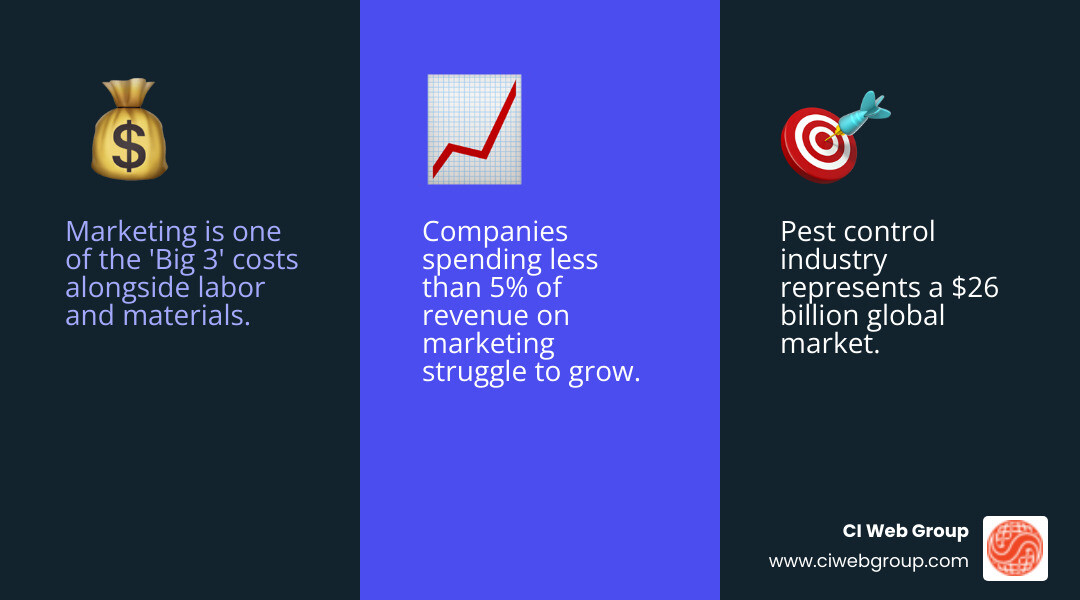
Here's the uncomfortable reality: many pest control companies either underspend on marketing entirely, or they spend without a plan and wonder why the phone isn't ringing. According to industry financial experts, marketing sits alongside direct labor and materials as one of the "Big 3" costs that make or break a pest control company. Get it right and your marketing budget becomes one of the best investments your business makes.
This guide walks you through exactly how to build a pest control marketing budget that drives real, measurable growth — from setting the right percentage of revenue to choosing the highest-ROI channels and tracking what's actually working.
I'm Jennifer Bagley, CEO of CI Web Group, and I've spent my career helping home service companies — including pest control operators — build data-driven marketing strategies that align with their revenue goals and operational reality. My work on pest control marketing budget frameworks is rooted in what I've seen already move the needle for service businesses competing in crowded local markets. In the sections below, I'll break down the exact process we use to help pest control companies spend smarter, not just more.
Pest control marketing budget terms you need:
One of the most common mistakes we see is applying a "one-size-fits-all" percentage to a pest control marketing budget. Your budget needs to mirror your business's current reality and your future ambitions. A company in the startup phase has vastly different needs than a mature enterprise focusing on retention.
In the Startup Stage, your goal is brand awareness. You are an unknown entity in a competitive market. We recommend allocating 2-5% of your projected first-year revenue. This initial "seed money" is vital for establishing your digital footprint, securing your website, and launching initial local search efforts.
As you move into the Growth Stage, your budget should increase to 5-10% of gross revenue. At this point, you have some recurring customers, but you need a steady stream of new leads to fill your routes. This is where Digital Marketing for Pest Control Companies becomes the engine of your business.
When you hit the Scaling Stage, you are looking to dominate your local market. This often requires an aggressive 10-15% of gross revenue. You aren't just looking for leads; you are looking to outspend and outmaneuver competitors in high-value zip codes. Finally, in the Mature Stage, companies often settle into an 8-12% range, balancing aggressive acquisition with heavy investments in customer retention and brand equity.
For most small-to-medium businesses (SMBs) in the pest control space, the gold standard benchmark is 7-10% of gross revenue. However, simply picking a number isn't enough. You must look at your Profit & Loss (P&L) statement through the lens of gross margins.
Industry experts often point out that comparing percentages alone can be misleading. You have to master your KPIs in the "Big 3": direct labor, materials, and marketing. If your labor costs are too high, your marketing budget will feel like a burden rather than an investment. Mature companies view marketing as a way to increase the long-term value of the company. Strategic Pest Control Content Marketing helps build that long-term value by establishing you as the local authority.
If your goal is to double your revenue over the next few years, you cannot stick to conservative benchmarks. Aggressive growth requires a budget of 10-15% of revenue.
In competitive markets like Houston, Texas, or the Pacific Northwest, "competitive density" is a real factor. If multiple companies are bidding for the same "termite control" keywords, your cost per lead will naturally be higher. You must calculate your budget based on the market share you want to capture. High-growth companies use a Pest Control Inbound Marketing Guide to ensure they aren't just buying clicks, but building a funnel that converts high-value, recurring customers.
Understanding your numbers is the difference between sustainable scaling and stagnation. Your Customer Acquisition Cost (CAC) is the total amount you spend on marketing divided by the number of new customers acquired.
Instead of focusing on static estimates, we look at channel efficiency. Local Services Ads (LSAs) often provide the highest immediate conversion rates, while SEO offers the best long-term ROI by reducing your reliance on paid media. Effective Pest Control PPC Management focuses on lowering that CAC while maintaining lead quality through AI-enhanced targeting.
We aim for a target ratio of 3:1. This means for every unit of currency you spend to acquire a customer, you should see at least three times that in return over that customer's lifetime. In pest control, where a high percentage of residential revenue is recurring, the long-term value of a contract far outweighs the initial acquisition cost.
Profitability thresholds improve when you focus on retention and upsell opportunities. For example, a customer who starts with a one-time treatment but is converted into a quarterly plan becomes significantly more profitable over time. We help clients use a Pest Control Content Marketing Guide to educate existing customers on additional services like mosquito control or rodent exclusion, boosting LTV without increasing acquisition spend.
One of the smartest ways to manage your pest control marketing budget is to fund future campaigns using the profits from existing recurring customers. This creates a self-sustaining growth model. Instead of dipping into operating capital, you use the "float" from your monthly service agreements to test new marketing channels.
This financial modeling is essential for Industries Pest Control specialists. By treating marketing as a reinvestment of profit rather than a static expense, you can scale your budget as your recurring customer base grows.
Where should you actually put your money? In 2025 and 2026, the landscape is shifting toward AI-driven search and high-intent local visibility. Your website is no longer just a digital brochure; it is your 24/7 salesperson, optimized for both humans and AI search engines.
Local SEO remains the highest long-term ROI channel. By optimizing your Google Business Profile (GBP) and building topical authority using Ahrefs and Moz methodologies, you can capture "near me" searches without paying for every click. We emphasize Pest Control Web Design Best Practices 2025 which include fast load speeds and clear calls-to-action that convert organic traffic into leads.
The era of Generative Engine Optimization (GEO) is here. AI search engines are now pulling answers directly from your website content. To stay relevant, your budget must include technical SEO that accounts for llm.txt optimization, structured data, and schema markup.
We utilize low-code development platforms like Webflow to ensure our clients' sites are mobile-responsive and incredibly fast—essential since a one-second delay in mobile load time can cost you significantly in conversions. A Pest Control Website Design Company Guide should prioritize these technical elements to ensure your marketing dollars aren't being wasted on a site that scares customers away.
Google Local Services Ads (LSAs) are often the most effective "quick win" for pest control. You pay per lead rather than per click, and the "Google Guaranteed" badge builds immediate trust. However, success here is an operational challenge—you must respond to leads within minutes to maintain your ranking.
Traditional PPC (Search Ads) still has a place, especially for niche services like bed bug heat treatments or termite barriers. By using retargeting ads, you can stay in front of people who visited your site but didn't book, increasing the likelihood of conversion. Our Pest Control Web Design Services integrate these tracking pixels from day one to ensure every ad dollar is tracked.
A budget without goals is just a shopping list. Your goals must be Specific, Measurable, Achievable, Relevant, and Time-bound (SMART). For example: "Increase recurring service revenue by 15% in the next 12 months by acquiring 30 new quarterly agreements per month."
One common mistake is ignoring route density. If you are a small operator in Houston, it’s better to spend your budget dominating a few specific neighborhoods than trying to cover the entire metro area. High route density reduces drive time and increases profit margins. We also recommend using SEO Strategies Pest Control Companies for Spring to ramp up spend just before the "bug season" hits.
Relying solely on one platform—like Facebook or Google LSAs—is dangerous. If an algorithm changes or a competitor outbids you, your lead flow could vanish overnight. Diversification is key to building brand equity.
Your pest control marketing budget should balance "owned" assets (your website, your email list) with "rented" space (ads). This builds long-term value that persists even if you dial back ad spend. A Pest Control Reputation Management Guide is a vital part of this strategy, as reviews are an asset that helps you convert leads across every single channel.
Pest control is inherently seasonal. You’ll likely see a surge in Q2 (Spring) for termites and ants, and a different spike in Q4 for rodents. Your budget should be dynamic:
Using a Pest Control Website Template that allows for easy seasonal updates ensures your site always reflects the current needs of homeowners in your area.
To truly optimize a pest control marketing budget, you need to know exactly which dollars are producing revenue. This requires integrating your marketing tools with your field service software, such as FieldRoutes or ServiceTitan, and adopting the HubSpot flywheel methodology to ensure a seamless customer journey.
When your CRM and marketing platforms talk to each other, you can see "closed-loop" reporting. You’ll know that a specific lead from a Facebook ad turned into a high-value termite contract. This data allows you to stop spending on underperforming channels and double down on winners. Our Pest Control Content Marketing 963ff strategies focus on creating high-intent content that feeds these automated systems.
The future of pest control marketing is "agentic." AI tools can now handle lead scoring, analyze which zip codes are most profitable, and even manage 24/7 chat responses to capture leads while you sleep.
Automated review requests via SMS after a service call can significantly boost your "review velocity," which helps you rank higher in the Google Local Pack. We emphasize data ownership—ensuring you own your website and your customer data—so you aren't locked into a single proprietary platform that charges you more as you grow.
Every quarter, you should conduct a performance audit. Track your Cost Per Lead (CPL), conversion rates, and total ROI. Revenue mapping—seeing where your most profitable jobs are located—can help you refine your geo-targeting for the next quarter.
By adjusting your budget based on real-world performance, you ensure that your marketing remains an engine for growth rather than a drain on resources.
Most established pest control companies spend between 7% and 10% of their gross revenue on marketing. Startups may allocate a higher percentage of their initial capital to establish a presence, while scaling companies often push toward 15% to capture market share in competitive regions like Houston or Dallas.
Divide your total marketing spend for a specific period by the number of new customers acquired in that same period. This allows you to measure the efficiency of your lead generation efforts without relying on generalized industry estimates.
It depends on your goals. If you need leads immediately, LSAs and PPC are the priority. However, if you want to lower your long-term costs and build an asset you own, SEO and AEO are the better investments. Most successful companies use a hybrid approach, using PPC to fund the time it takes for organic authority to kick in.
At CI Web Group, we believe your pest control marketing budget should be your most powerful tool for business growth. By moving away from "guesswork" and toward a data-driven, transparent strategy, you can dominate your local search market and build a business that lasts.
We provide customized programs with no contracts and complete client asset ownership. Our goal is to help you achieve your revenue targets in Houston, the Pacific Northwest, and beyond through strategic, AI-powered marketing. Ready to stop being bugged by costs and start seeing real ROI? More info about branding services is just the beginning of your growth journey.
Search our Blog
5 min read
Ultimate Checklist for HVAC Brochure Design
Master HVAC brochure design with this ultimate checklist covering layouts, content, and multi-channel strategies that convert.
Read more

5 min read
Beginner's Guide to Starting an Advertising Agency Online
Learn how to start an advertising agency online with this beginner's guide covering niche selection, tech stack, AI tools, client acquisition, and more.
Read more

5 min read
The Complete Guide to Plumbing Website Design
Discover expert plumbing website design strategies that boost conversions, mobile performance, and local SEO for your plumbing business.
Read more

5 min read
5 Ways to Find a Reliable Plumber Fast
Discover plumbing website content strategies that help homeowners find a reliable plumber fast with mobile-friendly design and trust signals.
Read more