.png)
5 min read
Your Website Has a New Visitor: AI Agents
Google's new "agent-friendly" guide changes everything. Learn how AI agents evaluate your website and how to ensure your business gets chosen in AI-driven search.
Read more
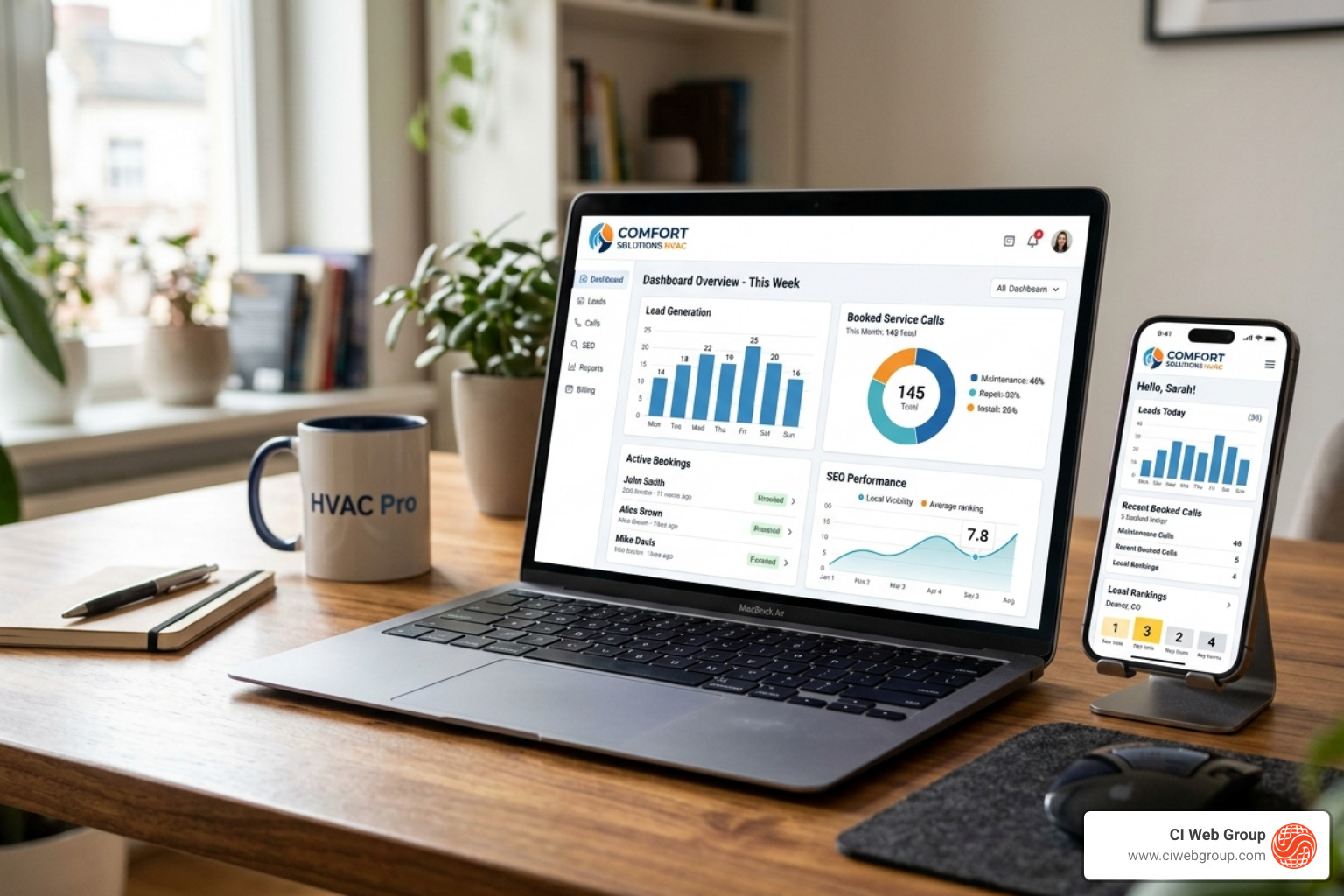
May 5, 2026
HVAC website optimization is the process of improving your heating and cooling company's website so it loads faster, ranks higher in local search, and converts more visitors into booked service calls. Here is what it covers at a glance:
| Optimization Area | What It Does for Your Business |
|---|---|
| Page speed & Core Web Vitals | Reduces bounce rate, improves Google rankings |
| Mobile-first design | Captures the 70%+ of HVAC searches done on phones |
| Local SEO & service area pages | Helps you rank for city-specific searches |
| Schema markup & structured data | Makes your services visible in AI and rich search results |
| Trust signals & social proof | Turns skeptical visitors into paying customers |
| High-converting forms & CTAs | Increases the rate of visitors who actually contact you |
| Online booking & chat tools | Captures leads around the clock, even after hours |
Most HVAC businesses are losing leads right now — not because of a lack of traffic, but because their website is too slow, too hard to use on a phone, or too vague about who it serves and where. Consider this: one in four visitors will leave a site that takes more than four seconds to load. Over 70% of local service searches happen on a smartphone. And 97% of people research a local company online before they ever pick up the phone. If your website is not built to handle that reality, you are handing calls to your competitors every single day.
The good news is that a full rebuild is rarely the answer. In most cases, targeted optimizations — fixing speed, mobile experience, trust signals, and local relevance — can dramatically improve performance in a matter of weeks, not months.
I'm Jennifer Bagley, CEO of CI Web Group, and I've spent years helping HVAC contractors and home service companies turn underperforming websites into their best lead generation tools through strategic HVAC website optimization. In the sections below, I'll walk you through exactly what to fix, why it matters, and how to measure results that move your business forward.
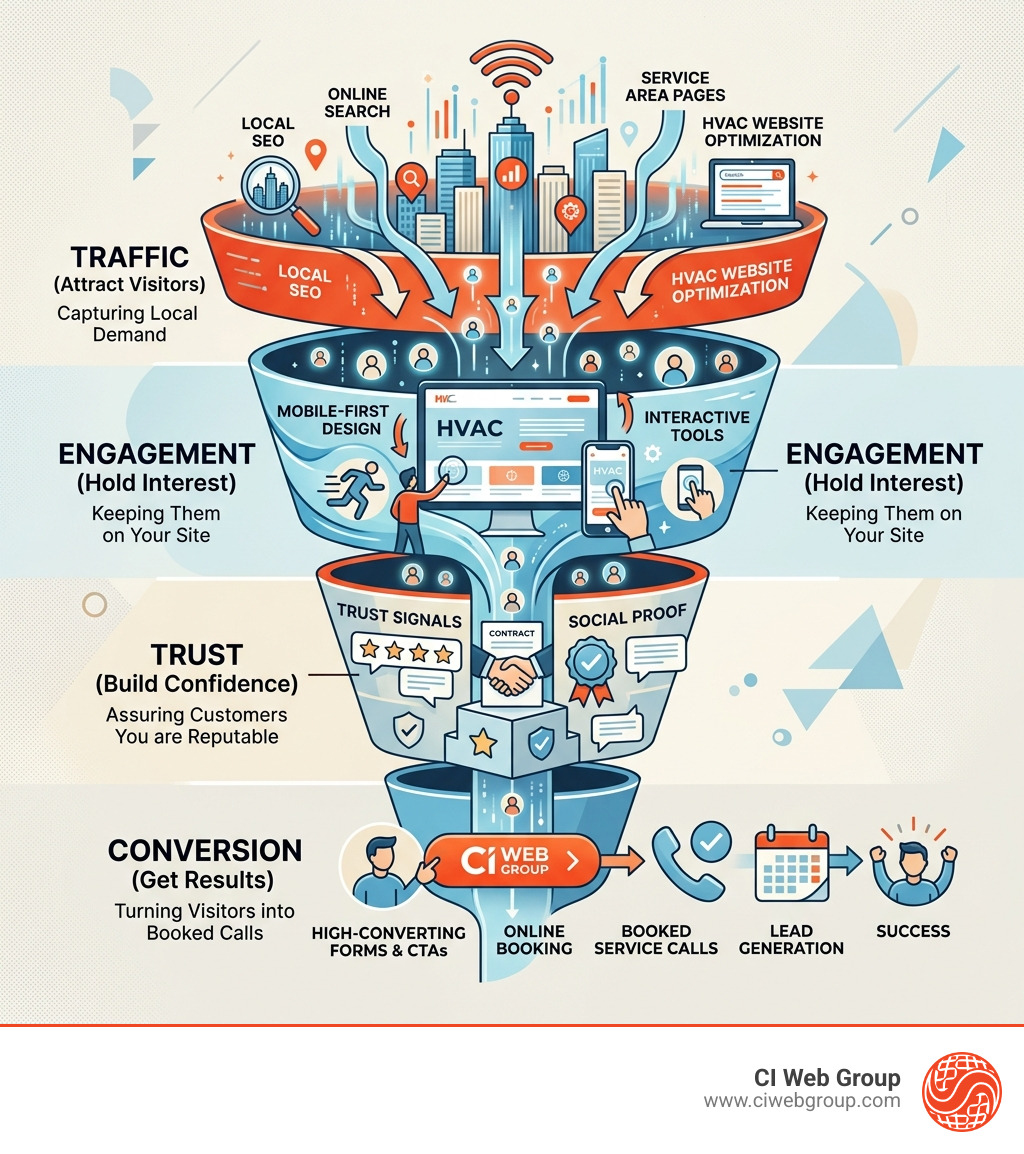
Basic HVAC website optimization vocab:

When an air conditioner fails in the middle of a Phoenix summer, the homeowner isn't looking for a "digital experience." They are looking for a solution—fast. This is where HVAC website optimization transitions from a technical task to a critical business lifeline. Emergency readiness means your site must be optimized for the "crisis-mode" user.
Data shows that optimized sites can see a 76% increase in emergency calls. Why? Because when the heat is rising, every second of friction on your site is a reason for that customer to hit the "back" button and call the next guy. We focus on mobile-first design and sticky click-to-call buttons that stay visible as the user scrolls. If they have to hunt for your phone number, you've already lost the job. For a deeper dive into the foundations, check out our HVAC SEO Ultimate Guide.
In HVAC, user intent is divided into two camps: researchers and emergency searchers. The emergency searcher has a high "pain point" and needs immediate info. Your site must present the most vital information "above the fold"—meaning the part of the screen visible without scrolling.
Since more than 70% of local searches happen on phones, your mobile layout is actually more important than your desktop view. If your site isn't optimized for thumb-sized targets and fast-loading contact info, your bounce rate will skyrocket. Learn more about capturing these mobile users in our guide on Content Cluster Mobile Optimization.
Ranking #1 in Google is great, but ranking #1 in the city where your trucks actually are is better. Local search dominance relies on "NAP" consistency (Name, Address, Phone number) and dedicated service area pages.
If you serve Phoenix, Scottsdale, and Mesa, you need unique content for each location. Google handles 94% of all searches, and it rewards sites that provide specific local cues. By using location-specific keywords and embedding Google Maps, we help you capture the 97% of people who learn about local companies online. Our Contractor Website SEO strategies ensure you aren't just visible, but dominant in your specific territory.
Speed isn't just a convenience; it's a ranking factor. Google's "Core Web Vitals"—specifically Largest Contentful Paint (LCP), First Input Delay (FID), and Cumulative Layout Shift (CLS)—measure how real users experience your site's speed and stability.
A one-second increase in load time can lift conversions by 2%, while a slow site can lose up to 40% of its visitors. Through HVAC website optimization, we’ve seen load times improve by 83%, leading to a 58% lower bounce rate. When your site loads in under two seconds, you aren't just pleasing Google; you're respecting your customer's time. Explore more technical details in our Webflow Speed Optimization guide.
Trust is the currency of the home service industry. You are asking strangers to let you into their homes to work on expensive, vital equipment. Your website needs to scream "reliability" from the moment it loads.
Trust signals like NATE certifications, BBB logos, and real team photos (not stock images!) are essential. Statistics show that businesses displaying at least five reviews see conversion rates rise by nearly 270%. We help you place these reviews at strategic decision points—right next to your "Book Now" buttons. See how we tailor these trust elements in our Custom Website Design for HVAC Companies in Florida (the principles apply to Phoenix too!).
Modern websites often get bogged down by heavy images and unoptimized code. To keep your site lean, we implement:
These technical adjustments are the "tune-ups" your website needs to run at peak efficiency. Check out our Webflow Technical SEO resources for more on these high-performance fixes.
The search landscape is changing. With the rise of Generative Engine Optimization (GEO) and AI-driven search, your website needs to "speak" the language of machines. This is done through schema markup—structured data that tells search engines exactly what you do, where you do it, and how people rate you.
By implementing HVACBusiness and Service schema, we help your site appear in "rich snippets" and AI-generated answers. This isn't just about ranking; it's about being the "cited source" when an AI tells a homeowner who to call. Learn how to stay ahead in our guide: Is Your Website Built for AI? A Guide for Home Service Businesses.
AI search engines love FAQs. By structuring your content around common customer questions—like "How much does a new AC cost?" or "What are the signs of a failing furnace?"—you increase your chances of appearing in the "People Also Ask" boxes.
FAQ schema can provide a 28% boost in AI citation visibility. This seasonal content strategy ensures you are answering the right questions at the right time, whether it's March (pre-summer cooling) or October (winter heating prep). Our Webflow Content Management system makes these updates seamless.
A "content cluster" is a group of related pages that establish you as an expert in a specific topic and area. For example, you might have a pillar page for "AC Repair Phoenix" supported by sub-pages for "Emergency AC Repair in Scottsdale" or "Ductless Cooling in Chandler."
This internal linking strategy builds topical authority, telling Google that you aren't just a general contractor, but the local expert. For a localized example of this in action, see our Flagstaff Custom HVAC Website Design Guide.
Traffic is a "vanity metric" if it doesn't lead to jobs. Conversion Rate Optimization (CRO) is the art of turning those visitors into leads. One of the biggest killers of conversions is "form abandonment." Long, intimidating forms drive people away.
By switching to smart, multistep forms—where you ask for the zip code first, then the service type—we've seen form completion rates jump from 12% to over 60%. It’s about making the process feel easy and low-pressure. Discover how to personalize this experience with AI-Powered Website Personalization with Webflow.
Your technicians stop working at 5 PM, but your website shouldn't. Integrating tools like online booking widgets and chat services allows you to capture leads at 2 AM on a Sunday.
These tools work as a "perfect bridge" between a searcher’s need and your dispatch software. Over 78% of leads go to the first company that responds, so having an automated way to "catch" that lead is vital. See how we implement these in local markets like our Chandler Custom HVAC Website Design projects.
Don't bury your reviews on a "Testimonials" page where no one goes. Instead, embed dynamic Google reviews right next to your contact forms and service descriptions.
When a customer is about to click "Schedule Service," seeing a 5-star review from someone in their own neighborhood provides the final nudge they need. 99% of people check reviews before calling a service provider—make it easy for them. This principle is a staple of Roofing Website Optimization and HVAC alike.
Many HVAC owners think they need a brand-new website every time their leads slow down. In reality, a full rebuild is often risky, slow (taking 2-3 months), and can temporarily hurt your existing SEO rankings.
| Feature | HVAC Website Optimization | Full Website Rebuild |
|---|---|---|
| Timeline | 2-3 Weeks | 2-3 Months |
| Cost | Lower/Targeted | Higher/Comprehensive |
| SEO Risk | Minimal (Preserves rankings) | High (Requires careful migration) |
| ROI Speed | Immediate technical gains | Delayed until launch |
| Best For | Improving what works | Outdated tech/rebranding |
Ongoing HVAC Website Maintenance and optimization are usually the more cost-effective paths to growth.
Optimization focuses on the "low-hanging fruit" that delivers the fastest ROI. We start with a technical audit to find what's broken—slow images, missing meta tags, or broken forms—and fix them first. This approach preserves your brand recognition while supercharging your site's ability to generate revenue. For those on high-performance platforms, Webflow Technical SEO provides the perfect foundation for these iterative wins.
To know if your optimization is working, you need to track the right KPIs (Key Performance Indicators):
Technical improvements like page speed show immediate benefits in user experience. Conversion improvements (like better forms) usually show results within the first two weeks. Full SEO benefits typically take 1-3 months as Google recrawls your improved pages.
Probably not. Most sites can be significantly improved through targeted HVAC website optimization. We focus on fixing your speed, adding local content, and cleaning up your technical SEO without the downtime of a full rebuild.
Speed is everything in an emergency. 53% of mobile users abandon a site if it takes longer than 3 seconds to load. In a "no-AC" emergency, customers are "speed dating" websites; the first fast, professional site they find is usually the one that gets the call.
At CI Web Group, we don't believe in "set it and forget it" marketing. We provide data-driven digital marketing for home service companies with a focus on complete transparency and client asset ownership. Our USP is simple: no contracts, 24/7 support, and customized programs designed to help you dominate your local market.
Your website should be your hardest-working employee, generating leads while you're out in the field. If your current site is more of a digital paperweight than a lead machine, it's time for a change.
Ready to see where your site stands? Get Your Free HVAC SEO Audit and discover how to outrank your competitors and get more service calls today.
Search our Blog
5 min read
How to Make Your HVAC Site Work Harder Than Your Technicians
Boost leads and emergency calls with HVAC website optimization. Turn your site into a high-performance conversion machine.
Read more
5 min read
Your Website Has a New Visitor: AI Agents
Google's new "agent-friendly" guide changes everything. Learn how AI agents evaluate your website and how to ensure your business gets chosen in AI-driven search.
Read more

5 min read
The Robot's Guide to SEO: Making AI Content Google-Friendly
Master SEO and ai generated content: Boost rankings 46%, dodge penalties, and future-proof for SGE with human-AI hybrid strategies.
Read more
5 min read
The Ultimate Guide to HVAC SEO Services in 2026
Dominate 2026 search rankings with HVAC SEO services. Generate high-intent leads, master local dominance & boost revenue growth.
Read more