5 min read
The New Google Search Is Here: Will Your Home Service Business Still Show Up?
Google just changed Search forever. Discover the 3 critical steps home service contractors must take right now to stay visible to AI search agents.
Read more
April 6, 2026
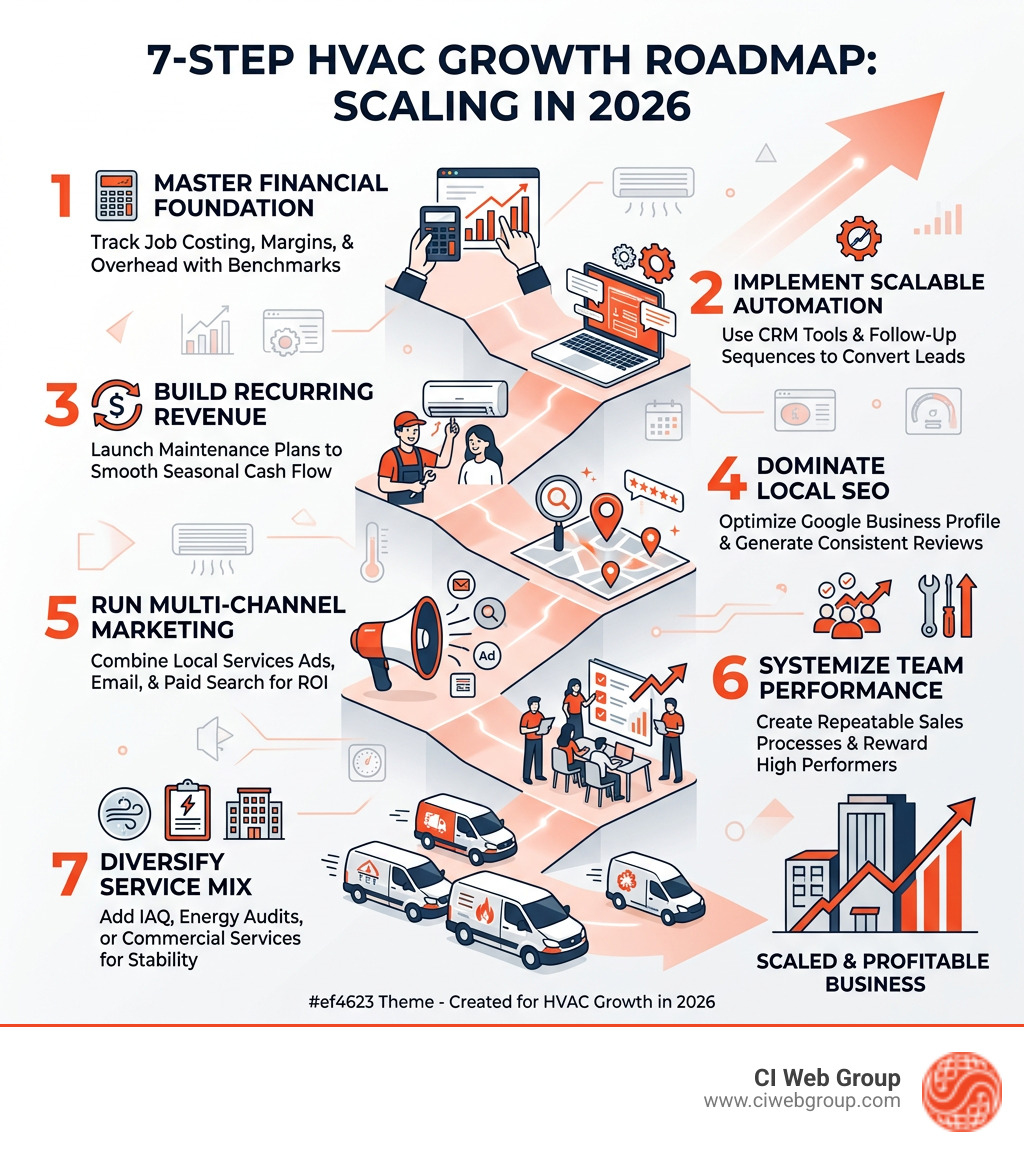
HVAC growth strategies are the structured, repeatable approaches that help heating and cooling businesses scale revenue, stabilize cash flow, and build operations that don't depend entirely on the owner. Here's a quick-reference overview before we dive deep:
7 Proven HVAC Growth Strategies for 2026:
The HVAC industry is at an inflection point. The global market is projected to grow from $310.58 billion in 2025 to over $438 billion by 2030, demand for more than 46,000 new technicians is expected by 2028, and extreme weather events are accelerating replacement cycles faster than ever. That's a massive opportunity.
But here's the uncomfortable truth: roughly 20% of HVAC companies fail every year, and over 60% report stagnant or declining profit margins. The businesses pulling ahead aren't necessarily working harder. They're operating smarter, with clearer systems, better financial visibility, and a digital presence that keeps the phone ringing even in the slow season.
Many HVAC owners are exceptional technicians who built their businesses on skill and reputation. The gap isn't in their craft. It's in the business infrastructure behind it — the pricing models, the follow-up systems, the marketing channels, and the financial tracking that turns a busy company into a profitable, scalable one.
This guide breaks down exactly what that infrastructure looks like, and how to build it step by step.
I'm Jennifer Bagley, CEO of CI Web Group and creator of the 12 Step Roadmap to Accelerated Results — a framework built specifically to help contractors implement effective HVAC growth strategies that align marketing, operations, and technology into one cohesive growth engine. Over the years, I've worked directly with HVAC and home service businesses to replace guesswork with systems that generate measurable, sustainable results.
HVAC growth strategies vocab explained:
Scaling an HVAC business is about moving from "hustle" to "leverage." Many owners find themselves trapped in a cycle where more revenue simply means more stress, more calls, and more fires to put out. To break this cycle, we must build a foundation of operational pillars that support growth without breaking the owner.
True growth requires moving beyond "gut feel" decision-making. We've seen companies generate $3 million in revenue yet lose money on half their jobs because they didn't account for drive time, callbacks, or material waste. By implementing rigorous job costing and financial benchmarking, you ensure that every hour your team spends in the field is contributing to the bottom line.
The most successful HVAC businesses aim for specific financial benchmarks that keep them healthy. While the average industry profit margin is often less than 2%, high-performing companies reach 10% to 20% through strategic planning.
Key Financial Benchmarks to Track:
To manage these numbers effectively, many owners find success by implementing a structured operating system. Why Every HVAC Business Should Consider EOS explains how a clear vision and accountability framework can transform "winging it" into a data-driven machine.
Scenario modeling is another vital tool. Before you hire three new technicians or buy two new vans, run "what-if" scenarios. How many additional installs do you need to cover that new overhead? Understanding your break-even point allows you to scale with confidence rather than hope.
One of the biggest missed opportunities in the industry is unconverted leads. Statistics show that 78% of homeowners choose the contractor who responds first, yet the average industry response time is a staggering 47 hours.
Automation solves this. By using Field Service Management (FSM) tools like ServiceTitan or Thryv, we can create systematic follow-up sequences. If a customer asks for a quote but doesn't book, an automated 7-touch sequence (a mix of texts and emails) can achieve response rates of over 90%.
Automation Opportunities for 2026:
If your revenue looks like a mountain range—peaking in summer and winter and crashing in spring and fall—you need maintenance plans. These memberships are the "holy grail" of HVAC growth strategies because they provide predictable cash flow and increase your business valuation.
A robust membership program smooths out seasonal dips. While 30% revenue drops are common in the off-season, companies with 40% of their revenue tied to recurring plans stay profitable year-round. Beyond the cash flow, these plans build immense HVAC Customer Retention. A customer with a service agreement is far more likely to approve a major repair or system replacement because the trust is already established.
| Metric | Traditional Model | Modernized (Recurring) Model |
|---|---|---|
| Profit Margin | 6-12% | 15-22% |
| Customer Retention | 40-55% | 70-90% |
| Seasonal Dips | High (30%+) | Low (Buffered by plans) |
| Business Value | 3-5x EBITDA | 8-11x EBITDA |
In 2026, your "shop window" isn't your physical building; it's the first page of Google. With 90% of consumers using the internet to find local businesses, your digital presence must be "sticky" and disruptive.
Local SEO is the engine that drives high-intent leads. When a homeowner’s AC dies in the Texas heat or a furnace fails in the Pacific Northwest, they search for "AC repair near me." To win that click, you need more than just a website; you need a dominant local footprint.
The Pillars of HVAC Local SEO:
Mastering HVAC Local Search ensures that you appear in the "Map Pack," which captures the lion's share of mobile clicks.
Relying on a single lead source is dangerous. A balanced marketing plan combines the long-term equity of SEO with the immediate results of paid advertising.
Essential Channels for 2026:
For a deeper dive into building a cohesive system, check out our HVAC Marketing Plan Ultimate Guide and explore HVAC Digital Lead Generation tactics that convert.
The HVAC landscape is shifting toward "Green Power" and smart technology. Owners who adapt their HVAC growth strategies to these trends will capture a market that is increasingly focused on energy efficiency and indoor health.
You can’t scale a business if you are the only one who knows how to sell. Training your technicians to be "solution providers" rather than just "fixers" is the fastest way to increase your average ticket. An experienced technician with proper sales training can generate over $1 million in annual revenue individually.
Building a "Recruiting Machine":The technician shortage is real, with 46,000 new roles needed by 2028. To grow, you must "always be hiring." Use apprenticeships to build your own talent pipeline, which can reduce turnover by 50%. Reward your team with "spiffs" for selling maintenance plans or IAQ products, and foster a culture where continuous learning is celebrated.
We also recommend using HVAC AI Marketing Best Tips to help your office staff manage the influx of leads, ensuring that your team's utilization remains high (target 75% or better).
Diversification is the ultimate hedge against market fluctuations. In 2026, homeowners are looking for more than just temperature control; they want healthy air and lower utility bills.
High-Growth Diversification Areas:
By focusing on HVAC Customer Retention through these add-on services, you turn a one-time repair customer into a lifelong client. To stay ahead of the curve, learn how to Future-Proof Your HVAC Business with AI-Powered Marketing.
Approximately 20% of HVAC companies fail annually. The most common pitfalls include chronic cash flow shortages (often due to poor seasonality planning), a lack of formal business systems, and "pricing by gut" rather than data. Many owners are great technicians but haven't yet mastered the financial skills required to manage overhead and labor costs effectively.
Successful HVAC businesses typically target a 10% to 20% net profit margin. To achieve this, you should keep your total expenses below 60% of gross revenue, maintain a gross profit of at least 40%, and keep overhead costs between 25% and 35%. Tracking these KPIs weekly allows you to make adjustments before a small leak becomes a financial crisis.
Automation acts as a "digital employee" that never sleeps. By automating review requests, you improve your local SEO ranking without lifting a finger. Automated follow-up sequences for "unscheduled estimates" can recover thousands of dollars in "lost" revenue. Additionally, post-service upsell emails for maintenance plans turn one-time service calls into recurring revenue streams automatically.
The path to 30% year-over-year growth in 2026 isn't found in working more hours—it's found in better systems. By mastering your financials, automating your follow-ups, and dominating your local search results, you can transform your HVAC business from a stressful job into a thriving asset.
At CI Web Group, we specialize in providing data-driven digital marketing specifically for home service companies. We believe in complete transparency, client asset ownership, and customized programs that help you dominate online search. Whether you are in Houston, the Pacific Northwest, or the Southeast, we are here to provide 24/7 support and the strategic roadmap you need to achieve your goals.
Ready to stop guessing and start growing? Visit our HVAC Industry Page to see how we can help you implement these HVAC growth strategies today.
Search our Blog
5 min read
The New Google Search Is Here: Will Your Home Service Business Still Show Up?
Google just changed Search forever. Discover the 3 critical steps home service contractors must take right now to stay visible to AI search agents.
Read more

5 min read
The Ultimate Contractor Growth Guide
Master digital marketing for contractors in 2026: SEO, PPC, AI search, GEO & reputation strategies to dominate local rankings and scale your business.
Read more

5 min read
Beyond the Business Card: Creative Marketing Materials for Exterminators
Boost pest control marketing materials with print assets, vehicle wraps, QR codes & ROI strategies for local dominance in 2026.
Read more

5 min read
Don't Sweat the Tech with These Software Solutions
Discover top HVAC software solutions for 2026. Streamline scheduling, dispatching, invoicing & more to boost efficiency & cash flow.
Read more