Why HVAC Local Search Drives Your Business Growth
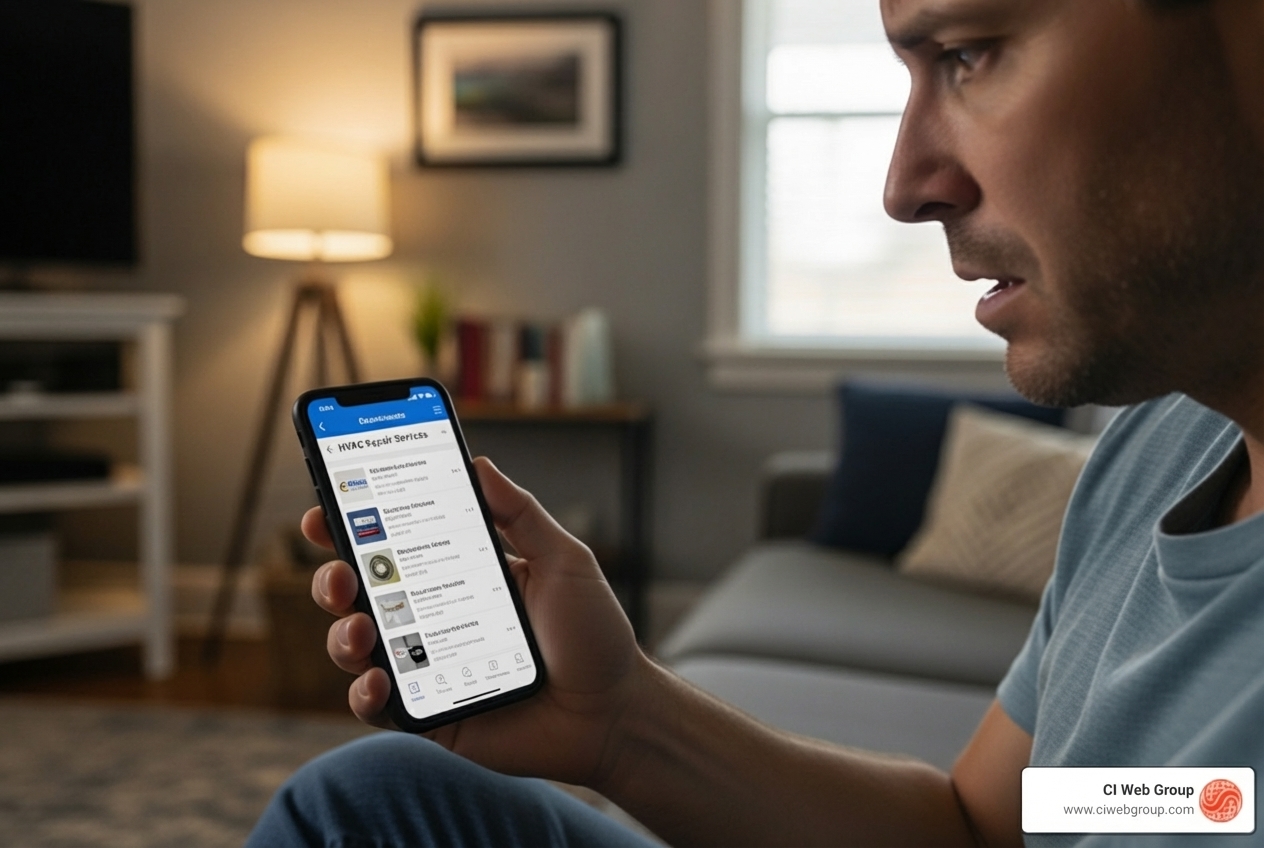
HVAC local search is how potential customers find your heating and cooling company when they need help right now. When someone's AC fails on a 95-degree afternoon or their furnace quits on a freezing night, they grab their phone and search for "AC repair near me" or "emergency HVAC service." If your business doesn't appear in those search results, you're invisible to the customers who need you most.
Quick Answer: How to Rank Higher in HVAC Local Search
- Optimize your Google Business Profile - Complete every field, add photos, respond to reviews, and keep hours updated
- Build NAP consistency - Ensure your Name, Address, and Phone number match exactly across all online directories
- Generate regular reviews - Ask satisfied customers for Google reviews and respond to all feedback
- Create location-specific website content - Develop dedicated pages for each city and service you offer
- Earn local backlinks - Get links from local chambers of commerce, community organizations, and industry directories
- Use local keywords naturally - Include your city name and service terms in page titles, headings, and content
The stakes are high. Over 1.5 billion "near me" searches happen every month, and 80% of local searches convert into customers. When your HVAC company dominates local search results, you capture emergency calls, seasonal installation opportunities, and maintenance contracts before your competitors even get a chance. The Google Map 3-Pack appears at the top of search results for most local queries, and 70% of all clicks go to businesses featured there.
Ready to boost your local visibility? Learn comprehensive strategies in our HVAC Marketing Guide, or schedule a free consultation to see how we can help your business dominate local search.
I'm Jennifer Bagley, CEO of CI Web Group, and I've spent over a decade helping HVAC contractors leverage HVAC local search to grow their businesses through proven digital marketing systems. What follows is a comprehensive guide to ranking higher and capturing more high-intent customers when they're actively searching for your services.
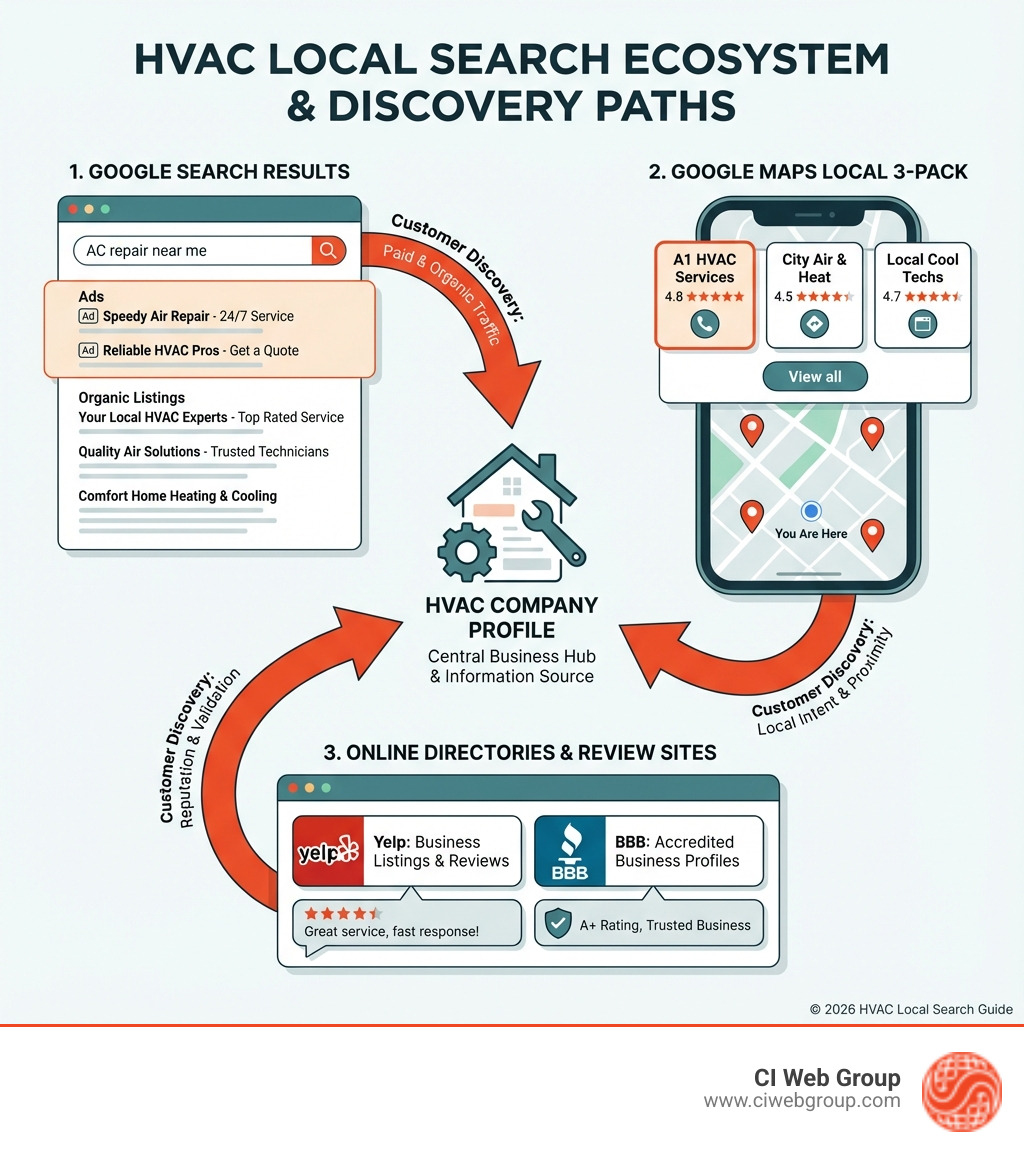
Simple HVAC local search word guide:
The Foundation: Mastering Your Google Business Profile
Your Google Business Profile (GBP) is arguably the most critical tool in your HVAC local search arsenal. Think of it as your digital storefront, prominently displayed on Google Search and Maps. For homeowners in Houston, across Texas, or throughout the Pacific Northwest, Southeast, and Southwest, your GBP is often the first interaction they have with your business. It's the engine of your local visibility, appearing in up to 93% of local searches and showing up in the coveted Google Map 3-Pack, which captures a staggering 70% of all clicks. Customers are 70% more likely to visit a business with an optimized GBP.
Google determines your local ranking based on three main factors:
- Relevance: How well your profile matches what someone is searching for. If a homeowner searches for "furnace repair Houston," Google looks for HVAC businesses that offer furnace repair in Houston.
- Distance: How far each potential search result is from the location keywords used in the search. Proximity matters immensely in HVAC local search.
- Prominence: How well-known your business is, based on factors like reviews, ratings, and online activity. A business with many positive reviews and an active online presence appears more prominent.
You can learn more about these three main ranking factors directly from Google.
Claiming and Verifying Your Profile
The journey to local search dominance begins with claiming and verifying your Google Business Profile. If you haven't already, you'll need to create your profile and then claim your business and verify ownership. This process typically involves Google sending a postcard to your physical address, a phone call, or an email verification.
For HVAC companies, consider if you operate as a Service Area Business (SAB) without a physical storefront that customers visit, or if you have a brick-and-mortar location. If you're an SAB, you'll specify your service areas (e.g., zip codes, cities) rather than a public address. If you have multiple locations, each one needs its own verified GBP. If you accidentally create duplicate listings, ensure you merge them to consolidate your online presence and avoid confusing Google and potential customers.
Essential GBP Optimizations for HVAC Local Search
Once your profile is claimed and verified, it's time to optimize it for maximum impact. Every detail matters for HVAC local search:
- NAP Consistency: This is foundational. Your Business Name, Address, and Phone Number (NAP) must be identical across your Google Business Profile, your website, and all other online directories. Inconsistencies can confuse Google and hurt your rankings.
- Primary Category: HVAC Contractor: This is non-negotiable. Your primary category must be "HVAC Contractor" to accurately signal your core service to Google.
- Strategic Secondary Categories: Don't stop at one! Add up to 10 secondary categories that accurately describe your specific services. For example, "Air Conditioning Repair Service," "Heating Contractor," "Furnace Repair Service," or "Air Duct Cleaning Service." These broaden the range of keywords your profile can rank for, helping you appear for more specific searches and potentially open uping 10x more search visibility.
- Detailed Service Descriptions: List all the services you offer – from AC repair and furnace installation to heat pump maintenance and indoor air quality solutions. Provide detailed descriptions for each, as these act as relevant keywords that help Google understand your offerings.
- Service Areas by Zip Code/City: Clearly define the specific areas you serve. This is crucial for Google to match your business with local searchers.
- Business Hours (including 24/7 Emergency): Provide accurate operating hours. For HVAC, list any 24/7 emergency services separately, as many customers search during off-hours when a crisis hits.
- High-Quality, Geotagged Photos: Visuals boost engagement. Upload professional photos of your team, your trucks, your work, and your facilities. Geotagging these photos (embedding location data) can further signal your relevance to local search engines.
- Connect with Callers: An optimized GBP makes it easy for potential customers to contact you, with 60% of searchers calling directly from the search results.
Actively Engaging Customers on Your Profile
An optimized GBP is not a "set it and forget it" task. Active engagement signals to Google that your business is alive, responsive, and values its customers, which directly impacts your "Prominence" factor.
- Google Posts for Seasonal Offers: Use Google Posts to share updates, promotions (e.g., spring AC tune-up discounts), seasonal tips, and news. This keeps your profile fresh and engaging.
- Q&A Section for Common Questions: Proactively answer frequently asked questions in your GBP's Q&A section. This provides valuable information to potential customers and helps Google understand your expertise.
- Responding to All Reviews: This is paramount. A steady flow of quality positive reviews and high ratings shows potential customers that others have had good experiences with your business, making them more likely to trust and choose you. Respond promptly and professionally to every review – both positive and negative. While 55% of negative HVAC reviews are often driven by delays and poor communication, 41% of positive reviews specifically mention friendliness and courtesy. Addressing concerns calmly and offering solutions for negative feedback can turn a bad experience into a positive impression. Aim to respond within two days or less, as customers expect swift replies.
- Messaging Feature: Enable the messaging feature on your GBP to allow customers to text you directly. This can be a convenient way for them to ask quick questions and for you to capture leads.
Building Authority: Website and Content Optimization
While your Google Business Profile is your storefront, your website is your showroom and information hub. It's where potential customers go to learn more, build trust, and ultimately convert into paying clients. A well-optimized website, combined with a strong GBP, creates a powerful synergy for HVAC local search. It improves user experience (UX) and drives conversion optimization.
Google prioritizes websites that offer a seamless experience, especially on mobile devices. Technical SEO ensures your site is fast, accessible, and easy for both users and search engines to understand.
- Mobile-First Mandate: With 57% of searchers using mobile devices to find local businesses online, your website must be mobile-friendly. Google indexes the mobile version of your site to determine its rankings, so a responsive design that adapts to different screen sizes is essential.
- Page Speed Importance: Google considers page speed a ranking factor for both mobile and desktop searches. Ideally, your web page's content should load in 2.5 seconds or less. Slow sites frustrate users and lead to higher bounce rates.
- Tools for Optimization: Regularly monitor your website's performance using tools like Google PageSpeed Insights.
- Responsive Design: Ensure your site automatically adjusts its layout and content based on the user's screen size and orientation.
- Image Compression: Large image files are a common culprit for slow page speeds. Use image compression tools like TinyPNG or ImageOptim to reduce file sizes without compromising quality.
Hyper-Local Content and Keyword Strategy
Your website content needs to speak directly to your local customers and address their specific needs. This means a strategic approach to keywords and localized content.
- Keyword Research Tiers: HVAC customers search with different intents. We categorize these into four tiers:
- Emergency & Problem: "AC not cooling Houston," "furnace repair Pacific Northwest," "water heater leaking Texas." These are high-intent, immediate need searches.
- Service & Solution: "HVAC installation Southwest," "duct cleaning Southeast," "heat pump maintenance Texas." Customers know what they need, but are researching providers.
- Brand & Comparison: "Trane vs. Carrier HVAC Houston," "best HVAC company Texas reviews." Customers are evaluating options.
- Informational & DIY: "how to change HVAC filter," "why is my AC making noise." These build trust and expertise.Conduct thorough keyword research using tools like Google Keyword Planner or SEMrush to identify these terms for your specific service areas.
- Creating City/Service Area Pages: If you serve multiple cities or distinct neighborhoods, create dedicated landing pages for each. These hyper-local pages should feature unique content relevant to that specific location, including testimonials from local customers, area-specific HVAC concerns (e.g., humidity in Houston), and local landmarks. This helps you rank for "+near me" and "+city/county+service" keywords. For example, a high-performing page like this Nashville landing page can attract thousands of local visits monthly by optimizing for local keywords.
- On-Page SEO: Title Tags, Meta Descriptions, Headers: Integrate location-specific keywords naturally into your page titles, meta descriptions, and header tags (H1, H2, etc.). For instance, your title tag could be "AC Repair Houston, TX | [Your Company Name]." This signals strong relevance to search engines.
- Using Location-Specific Keywords: Distribute local terms naturally throughout your body content, meta descriptions, title/header tags, and URL slugs. Avoid keyword stuffing; focus on providing valuable, informative content.
Implementing Local Schema Markup
Schema markup is a form of microdata that you add to your website's HTML to help search engines understand and classify your content. For HVAC local search, it's like speaking Google's language.
- What is Schema Markup: These are specific code snippets that provide additional context about your business to search engines.
- LocalBusiness & HVACBusiness Schema: By implementing
LocalBusiness or HVACBusiness schema, you can explicitly tell Google your business's name, address, phone number, hours of operation, services offered, and even customer reviews. - Benefits for Search Engines: This helps Google easily find relevant data about your business and can lead to "rich snippets" in search results, such as star ratings, operating hours, and location on a map, making your listing stand out.
- Tools for Implementation: You can use Google’s Structured Data Testing Tool to test your schema markup and identify any errors.
Expanding Your Reach: Citations, Reviews, and Backlinks
Beyond your Google Business Profile and website, building a robust online presence involves expanding your reach through consistent citations, a proactive review strategy, and earning high-quality local backlinks. These are crucial off-page SEO factors that build trust signals and improve your online reputation management.
The Power of Consistent Citations
Citations are online mentions of your business's Name, Address, and Phone Number (NAP). They can appear on local directories, social media platforms, or other websites.
- What are NAP Citations: These mentions serve as digital breadcrumbs that help search engines verify your business's existence and legitimacy.
- Importance of Consistency: Inconsistent NAP data across different platforms can confuse search engines, making them hesitant to rank your business accurately. This can significantly hurt your HVAC local search visibility.
- Top HVAC Directories: Listing your business on reputable online directories is essential. Key platforms include:
- Yelp: A popular review site where many customers look for local service providers.
- Better Business Bureau (BBB): Builds trust and credibility, especially for service-based businesses.
- Nextdoor: A hyperlocal social networking service where neighbors often ask for recommendations.
- Tools for Consistency: Use tools like Semrush’s free list management audit tool to check if your NAP details are accurate and consistent across the web. This tool can help you find, claim, and update your listings.
A Proactive Review Generation Strategy
Customer reviews are one of the most powerful local ranking factors. Google considers review quantity, quality (star rating), recency, and keywords within review text when ranking local results.
- Why Reviews Are a Top Ranking Factor: Positive reviews and high ratings above 4 stars make customers more likely to trust and choose you. Online directories also rank local businesses according to ratings. A recent local SEO ranking study revealed a strong correlation between the number of reviews and Google Maps ranking.
- Statistics on Consumer Trust: A staggering 87% of consumers use Google to find, review, and hire local businesses. This makes reviews a cornerstone of your digital reputation.
- How to Ask for Reviews: Don't be shy! Implement a proactive strategy:
- Automate Requests: Send automated review requests via text or email immediately after completing a service.
- Direct Links: Make it easy for customers by providing a direct link to your Google Business Profile review page.
- In-person Ask: Encourage your technicians to politely ask satisfied customers for a review during or after service.
- Responding to Positive and Negative Reviews: Engaging with reviews signals to Google that your business is active and values its customers. Respond to positive reviews with gratitude. For negative reviews, respond professionally, empathetically, and offer to resolve issues offline. This demonstrates excellent customer service and can mitigate the impact of a bad review.
Earning High-Quality Local Backlinks
Backlinks (external links from other websites to yours) are like votes of confidence. When reputable local websites link to your site, it tells Google that your content is credible and important to local searchers, boosting your domain authority.
- Why Backlinks Matter for Authority: Pages with more high-quality backlinks tend to rank better. Google's top search result often has an average of 3.8x more backlinks than those in positions two through ten.
- Strategies for Local Backlinks:
- Local Sponsorships: Sponsor local sports teams, community events, or charities. Often, their websites will include a link back to your business as a sponsor.
- Chamber of Commerce: Join your local Chamber of Commerce. They typically have an online directory where your business will be listed, often with a link to your website. Visit the US Chamber of Commerce directory to find yours.
- Community Involvement: Engage in local events, volunteer, or partner with other local businesses. These activities can lead to mentions and links from local news sites or community blogs.
- Guest Posting on Home Improvement Blogs: Pitch articles to local home improvement blogs or news sites, offering valuable content in exchange for a backlink.
- Local News Sites: Contribute to news articles or offer expert commentary to local news outlets. You can meet reporters through platforms like Connectively (formerly HARO).
Focus on quality over quantity. A few relevant, high-authority local backlinks are far more valuable than many low-quality, irrelevant links.
Advanced Strategies for Dominating HVAC Local Search
To truly dominate HVAC local search in competitive markets like Houston or the Pacific Northwest, we need to look beyond the fundamentals and accept advanced strategies that anticipate future trends and leverage emerging technologies.
Optimizing for Voice Search and "Near Me" Queries
Voice search is increasingly popular, especially for local queries. Customers often use conversational language with virtual assistants.
- Statistics on Voice Assistant Usage: With 62% of US residents using voice-activated assistants like Siri, Google Assistant, and Alexa to find local businesses, optimizing for voice search is crucial.
- Using Conversational, Long-Tail Keywords: Voice queries are typically longer and more conversational than typed searches. Instead of "AC repair," a customer might ask, "Hey Google, find the best AC repair company near me that's open now." Focus on long-tail keywords that mimic natural speech.
- Structuring Content in a Q&A Format: Create content on your website that directly answers common questions customers might ask via voice search. This could be an FAQ page or blog posts titled "What to do if your furnace isn't heating in [City Name]?"
The Impact of AI on Local Search
The landscape of search is rapidly evolving with the integration of Artificial Intelligence, influencing how information is presented and ranked. Google's AI Overviews and AI Mode are changing the game.
- Google's AI Overviews: These AI-generated summaries often appear at the top of search results, directly answering user queries. To be featured, your content needs to be comprehensive, accurate, and authoritative.
- E-E-A-T Signals: Experience, Expertise, Authoritativeness, and Trustworthiness (E-E-A-T) are more important than ever. Demonstrate these by showcasing technician certifications, years in business, customer testimonials, and authoritative content.
- AI Crawlability: Ensure your website is accessible to AI bots. If Google Gemini (Google's AI model) cannot crawl and access your website, it won't be referenced in AI-generated responses. Regularly check your CDN settings to ensure no blocks or throttling.
- Query-Fan Out Optimization: AI search engines often search for multiple queries simultaneously. To appear in AI-generated results, your target pages must rank for multiple long-tail queries, not just the primary keyword. This means creating rich, detailed content that covers a broad spectrum of related questions and terms.
Measuring Your Local SEO Success
You can't improve what you don't measure. Tracking your HVAC local search performance is essential to understand what's working and where to adjust your strategy.
- Key Performance Indicators (KPIs): Monitor metrics such as:
- Local 3-Pack Rankings: How often your business appears in the top three map results for key queries.
- Google Business Profile Views & Actions: Track profile views, website clicks, direction requests, and phone calls directly from your GBP.
- Website Traffic from Local Searches: Use Google Analytics to see how much traffic comes from local organic search.
- Conversion Rates: How many website visitors or GBP interactions turn into actual leads (calls, form submissions, booking requests).
- Review Velocity & Average Rating: Monitor the number of new reviews and your overall star rating.
- Tools for Tracking: Leverage powerful tools:
- Google Search Console: Provides insights into your website's search performance, including keywords, impressions, and clicks.
- Google Business Insights: Built into your GBP, this offers valuable data on how customers interact with your profile.
- Google Analytics: Provides in-depth data on website traffic, user behavior, and conversions.
- Tracking Calls and Form Submissions: Implement call tracking numbers and conversion tracking for your website forms to accurately measure leads generated from your local SEO efforts. This helps us tie your online visibility directly to your bottom line.
Frequently Asked Questions about HVAC Local SEO
We often hear similar questions from HVAC business owners looking to boost their local presence. Let's tackle some of the most common ones.
How long does it take to see results from local SEO?
HVAC local search is a marathon, not a sprint. While top-ranking pages often have an average age of over two years, you can typically expect to see initial movement in local rankings and map visibility within 3-4 months. Achieving dominant, page-one rankings for competitive terms like "AC installation Houston" or "furnace repair Pacific Northwest" usually takes 6-12 months of consistent effort. Patience and persistence are key, but the long-term ROI is substantial.
Can I do local SEO myself, or should I hire an agency?
You can certainly handle some basic HVAC local search tasks yourself, such as claiming your Google Business Profile and adding initial information. However, effective local SEO is a full-time job that requires technical expertise, constant adaptation to Google's ever-changing algorithms, and specialized tools. Given the nationwide shortage of HVAC technicians and the demands of running your business, your time is often best spent focusing on your core operations while experts manage the complex work required to generate sustainable results. A specialized agency brings dedicated expertise, advanced tools, and a proven track record, ultimately saving you time and delivering superior outcomes.
What's the most important first step in local SEO for an HVAC company?
Without a doubt, the most important first step is to claim and completely optimize your Google Business Profile. It is the cornerstone of your local visibility. An empty or incomplete profile is a missed opportunity. Ensure every field is filled out, your categories are precise, your services are detailed, and your photos are high-quality. This foundation will set you up for success in all other aspects of HVAC local search.
Conclusion: Turn Local Searches into Service Calls
In the competitive world of HVAC, simply being a great technician isn't enough. You need to be easily found by the homeowners who need your expertise most. Mastering HVAC local search is no longer a luxury; it's a critical investment for capturing emergency calls, securing seasonal business, and building a sustainable future for your company.
By focusing on a consistent, specialized strategy that encompasses:
- A fully optimized Google Business Profile,
- A fast, mobile-friendly website with hyper-local content,
- A strong network of consistent citations,
- A proactive approach to generating and responding to customer reviews,
- And strategic local backlink building,
your HVAC business can climb the local search rankings, increase your online visibility, and turn those urgent "near me" searches into valuable service calls.
At CI Web Group, we understand the unique challenges and opportunities within the HVAC industry, particularly in dynamic markets like Houston, Texas, the Pacific Northwest, Southeast, and Southwest. Our data-driven digital marketing solutions are designed to help home service companies like yours dominate online search. We offer complete transparency, client asset ownership, 24/7 support, and customized programs, all without long-term contracts.
Ready to stop watching competitors get the calls and start growing your business? Learn more about our HVAC marketing services and find how we can help you achieve your goals.