5 min read
The Ultimate Contractor Growth Guide
Master digital marketing for contractors in 2026: SEO, PPC, AI search, GEO & reputation strategies to dominate local rankings and scale your business.
Read more
May 22, 2026
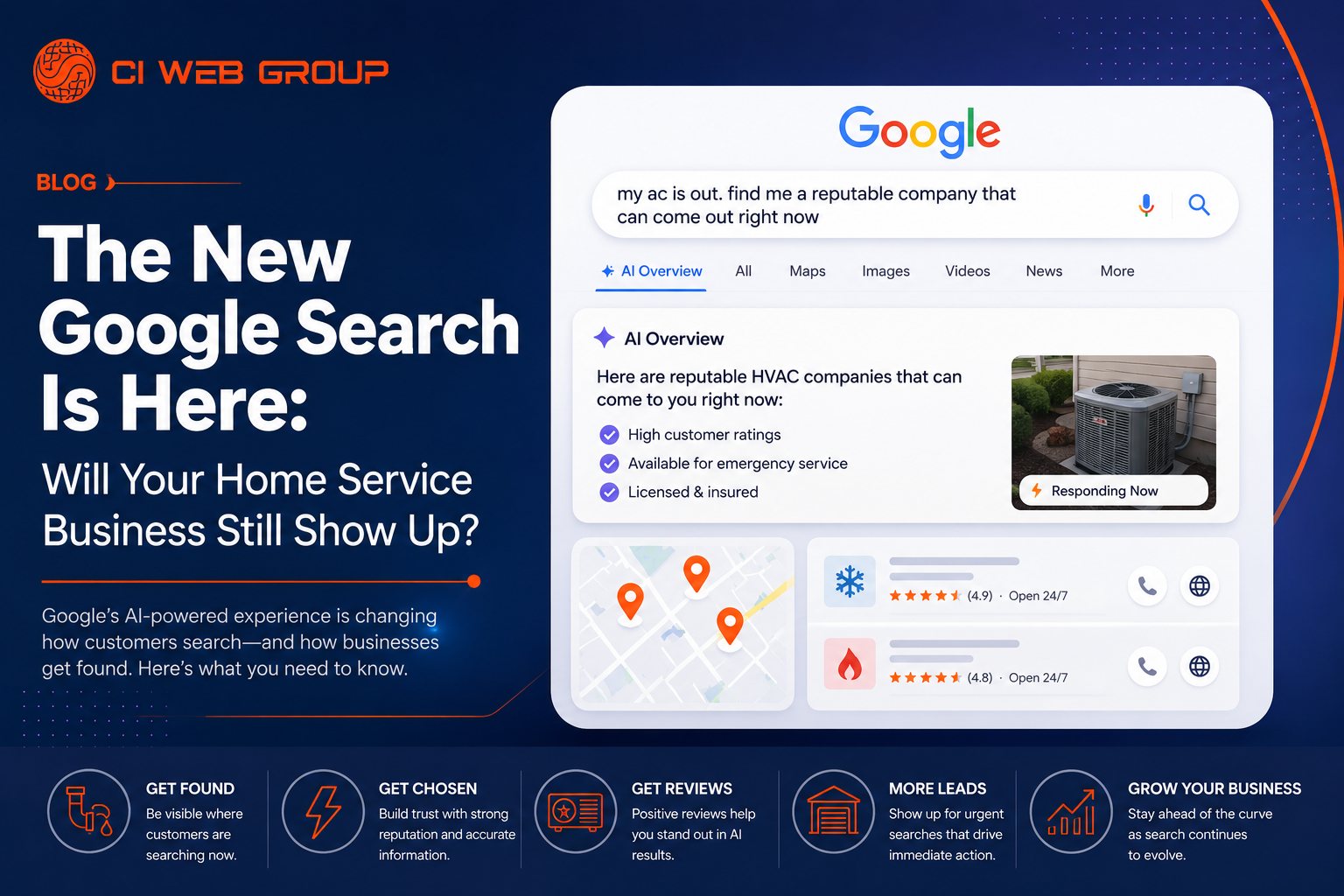
On May 19, Google announced its most significant change to Search in over 25 years—their words, not ours. For home service business owners, this isn't a story about technology. It's a story about who gets the job and who gets passed over before a customer ever picks up the phone.
The customer journey for home services used to start with a search. It now starts with an AI forming an opinion about your business before the customer even sees your name.
Google is replacing the classic keyword bar with an AI-powered interface built on Gemini 3.5 Flash. It expands dynamically, accepts text, images, files, videos, or open browser tabs as inputs, and is designed to interpret intent rather than match keywords.
The practical shift: customers are no longer typing "HVAC repair near me." They're describing a situation, such as "my AC stopped working and I have family coming this weekend", and expecting Search to determine who can help. If your business can't be understood in that context, it won't appear in the results.
Google is launching information agents, which are AI that monitors the web continuously on a user's behalf and surfaces relevant results at the right moment. These agents are designed for ongoing task such as a homeowner researching the best multi-zone ductless mini-split systems over a few weeks, tracking local contractor reviews, rebate changes, and equipment availability before pulling the trigger.
For home services, the implication is direct. An agent evaluating "reliable plumbers in my area" is not scanning for keywords. It is weighing trust signals: review volume and recency, consistency of your business information across the web, and how clearly your services and service area are structured online. Gaps in any of those areas affect how you are evaluated before a human has decided to search for you at all.
This is the detail that warrants the most immediate attention. For categories including home repair, Google can now call businesses directly to confirm pricing, availability, and details on behalf of customers before presenting that business as a recommendation.
Your phone handling, scheduling system, and online information need to reflect the same reality. If your website says you offer 24-hour emergency service but your answering system doesn't support it, an AI calling agent will find that out. So will the customer rating you afterward.
Using a platform called Antigravity, Google Search can now generate custom interfaces on the fly based on a user's query. A homeowner planning a renovation might see a personalized project tracker assembled in real time, pulling in pricing, local business data, reviews, and availability. These are not static results pages. They are task-specific experiences built from structured data.
If your service details, coverage area, and pricing are not formatted in a way that is machine-readable, you are not a candidate for those experiences. You will not appear in them regardless of how strong your traditional SEO has been.
On The Boardroom and our Catalyst for the Trades podcast series, we have spent the past year discussing the shift from traditional SEO toward Answer Engine Optimization (AEO) and Generative Engine Optimization (GEO)—positioning your business to be understood and cited by AI systems, not just ranked by algorithms. Google I/O 2026 confirms that transition is underway at scale.
The businesses that are positioned to benefit are those that have already treated their digital presence as a data structure, not just a website.
Run your business name through AI Mode in Google Search and through ChatGPT. See how you are described. That output reflects how AI agents currently understand your business. Gaps in reviews, inconsistent NAP data (name, address, phone), or thin service descriptions will surface here before they cost you a booking.
If your website, Google Business Profile, and phone system don't tell the same story about what you offer and when, an AI calling agent will surface that inconsistency. Audit those touchpoints as a system, not individually.
Schema markup for your service types, service area, hours, and pricing gives AI systems something concrete to work with when building generative results. Without it, you are invisible to the experiences Google is building.
These three steps are critical for immediate survival, but they are just the starting point for a comprehensive, AI-ready digital strategy. To assess how your business is currently positioned for agentic search, start your journey at getstarted.ciwebgroup.com.
Search our Blog
5 min read
The New Google Search Is Here: Will Your Home Service Business Still Show Up?
Google just changed Search forever. Discover the 3 critical steps home service contractors must take right now to stay visible to AI search agents.
Read more
5 min read
The Ultimate Contractor Growth Guide
Master digital marketing for contractors in 2026: SEO, PPC, AI search, GEO & reputation strategies to dominate local rankings and scale your business.
Read more
5 min read
Beyond the Business Card: Creative Marketing Materials for Exterminators
Boost pest control marketing materials with print assets, vehicle wraps, QR codes & ROI strategies for local dominance in 2026.
Read more

5 min read
Don't Sweat the Tech with These Software Solutions
Discover top HVAC software solutions for 2026. Streamline scheduling, dispatching, invoicing & more to boost efficiency & cash flow.
Read more