
5 min read
16 Tested Ways to Get More Garage Door Repair Leads
Get more garage door repair leads now! Discover 16 tested ways to grow your business using local SEO, PPC, and smart digital strategies.
Read more

September 26, 2025
Content cluster competitive analysis is the process of studying how competitors structure their content around specific topics. This helps you identify gaps, opportunities, and winning strategies for your own SEO efforts.
This analysis reveals:
Think of it as reverse-engineering a successful recipe. When a competitor ranks on page one for multiple related keywords, they're likely using a content cluster strategy. Analyzing their content isn't about copying; it's about understanding what works and doing it better.
Many marketers use competitor data to differentiate their content strategy. They use data to make smart decisions about where to invest their content creation efforts.
For home service companies, this approach is game-changing. Instead of creating random blog posts, you can build topic clusters that establish your expertise and dominate search results for entire categories of keywords related to your services.

Think of your website like a well-organized bookstore where related topics are grouped together. Content clusters apply this same logic to your digital content strategy, creating a connected web of pages focused on one main topic. This structure signals to search engines that you are an authority, making your content more likely to rank higher by building the E-E-A-T (Experience, Expertise, Authoritativeness, and Trustworthiness) that Google values.
A content cluster uses a hub-and-spoke model. At the center is your pillar page, a comprehensive overview of a broad topic. Radiating from the pillar are cluster content pages, which dive deep into specific subtopics and target long-tail keywords.
Internal linking connects these pages, guiding users and search engines through your expertise. For example, Zapier's ultimate guide to remote work is a pillar page that links to specific articles on remote team management and productivity tools.
Understanding how clusters work is key to competitive analysis. They are powerful because they:
A successful cluster has two main parts. The pillar page is a comprehensive guide on a broad topic, like this one on fast fashion by Good on You. It serves as a launchpad for deeper exploration.
Cluster content pages target specific subtopics and long-tail keywords. These are the detailed articles that answer the exact questions your customers have. Each cluster page links back to the pillar, reinforcing its authority, and the pillar links out to relevant cluster content, creating a powerful content ecosystem.
Now, let's dive into the detective work. This systematic approach provides a clear roadmap for understanding and outperforming your competition's content strategy. By reverse-engineering their success, you can learn from their strategic content ecosystem and improve upon it.
Your biggest SEO competitors might not be who you think. Your true search competitors are any websites ranking for your target keywords and capturing your potential customers' attention. This could include direct business rivals, DIY blogs, or national home improvement sites.
Start by brainstorming your most important service-related keywords, like "water heater repair" or "AC maintenance." Search for these terms in incognito mode and note the websites that consistently appear on page one.
SEO tools can accelerate this process. By inputting your domain, they can reveal other sites ranking for similar keywords, providing valuable intel you might have otherwise missed. Also, consider market segment analysis to identify industry influencers or large information sites capturing your audience.
This step is about understanding how competitors organize their content. We're looking for patterns in their website architecture and content categorization that reveal their cluster strategy.
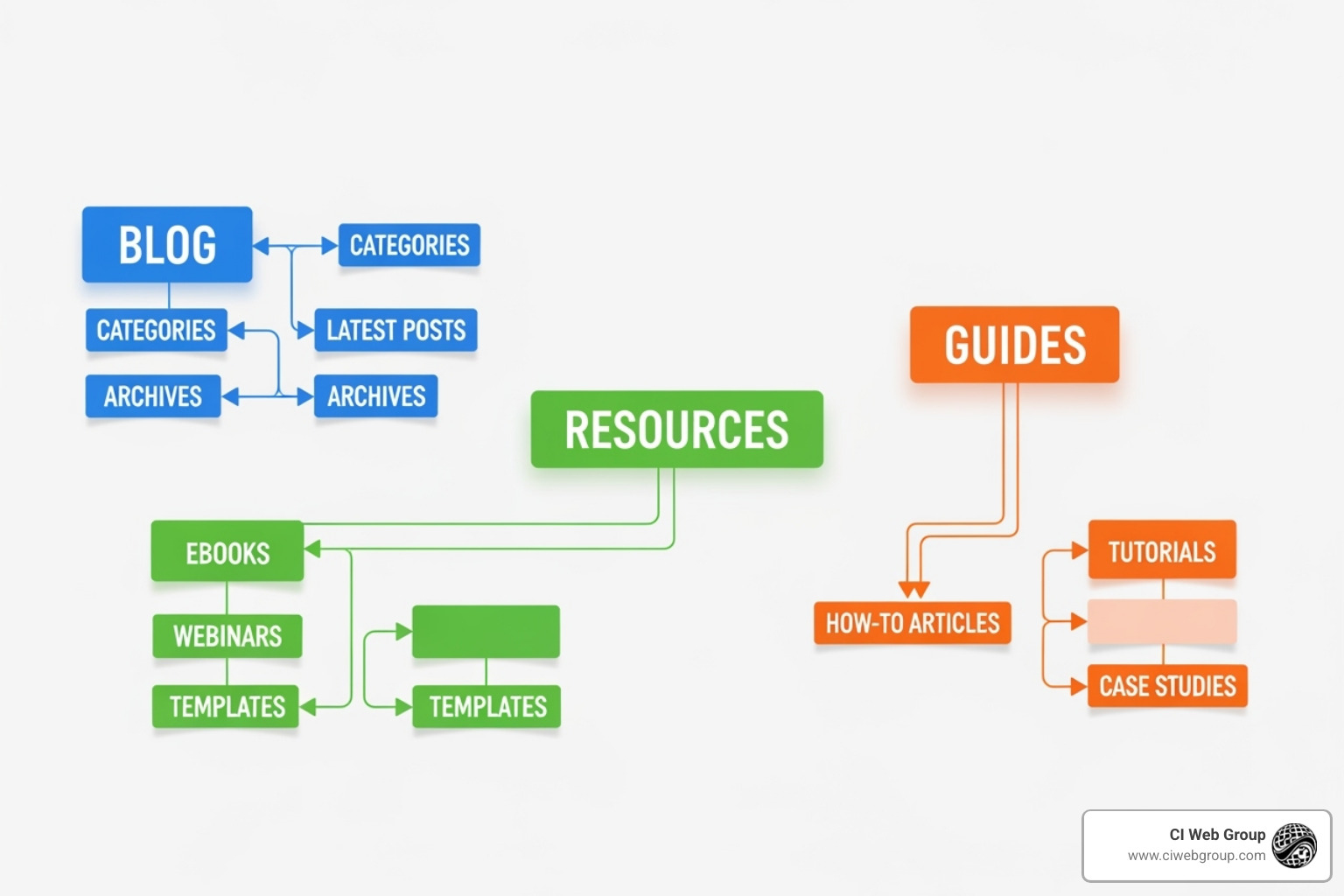
Manually browse their 'Blog', 'Resources', or 'Guides' sections. Pay attention to their navigation structure and look for main categories that branch into subcategories, suggesting topic clusters. Also, note their internal linking patterns. Do comprehensive articles link to more specific ones, and do those articles link back? This interconnected web is the hallmark of a content cluster. The goal is to reverse-engineer their content blueprint.
Now we gather quantitative data on their content performance using SEO tools.

This is where you find what your competitors are missing. It's not about copying; it's about finding unanswered questions and open content gaps.
Look for missing subtopics within their clusters. If they cover water heater repair but miss tankless water heater maintenance, that's your opportunity. Read their articles critically to see if they fail to satisfy search intent.
Content formats offer another way to stand out. If competitors only use blog posts, consider creating videos, infographics, or podcasts. Many marketers successfully differentiate by using formats their competitors ignore.
Internal linking is the secret sauce. Analyze how their pillar pages connect to cluster content. Are the links contextual and helpful? Do cluster pages link back to the pillar? This two-way linking reinforces authority.
Pay attention to the anchor text they use; it should be descriptive and keyword-rich. Also, note the link placement, as links higher in the content carry more weight. A successful cluster evolves over time with strategic internal linking, keeping visitors engaged within their content ecosystem.
Now it's time to turn your detective work into action. Competitive analysis is only valuable when you use the insights to create something better. We've gathered the intelligence; now let's build a content strategy that dominates.
Your research provides a goldmine of information for creating 10x content that offers exceptional user value. Use your findings to create content that is more comprehensive, up-to-date, and valuable than what your competitors offer.
For example, if a competitor's pillar page on "Water Heater Repair" is 2,000 words, create a 3,500-word guide with troubleshooting videos and local maintenance tips. The content gaps you found are golden opportunities. If competitors miss subtopics like "HVAC Maintenance in High-Humidity Climates," fill those voids with authoritative content.
Create a unique selling proposition that makes your content stand out. Instead of just filling gaps, find a unique angle or voice that builds brand preference.
Your home service company has deep local knowledge that national competitors can't replicate. Use your experience in the Pacific Northwest or Southwest to create unique, relevant content. Original research and expert interviews with your own technicians create content that's impossible to duplicate. Also, consider formats your competitors aren't using, like interactive tools or video walkthroughs.
Technology can make competitive analysis faster and more thorough. AI research tools can accelerate the process of gathering and synthesizing competitor data.
AI capabilities can automate:
AI can also help with continuous monitoring, alerting you to competitor updates and keeping you one step ahead.
Competitive analysis is an ongoing process of continuous improvement. Regularly compare your existing clusters against your competitors' to identify areas for improvement, updates, or expansion.
Start with performance benchmarking to see how your clusters perform against competitors. A regular content audit helps you identify which pieces need refreshing, which topics need deeper coverage, and where new content could strengthen your topical authority. The competitive landscape is always changing, and regular audits ensure your strategy stays relevant and effective.
Even the most well-intentioned content cluster competitive analysis can go wrong without proper planning. Avoiding common mistakes is just as important as following best practices for sustainable growth. Fortunately, most pitfalls are avoidable once you know what to look for.
The biggest mistake is blindly copying competitors. The goal is to understand the 'why' behind their success, not just imitate the 'what'. Copying without understanding misses the strategy and can harm your rankings if search engines detect duplicate content.
Other common traps include:
The ideal frequency depends on your market and resources. For most home service companies, a two-tiered approach works best.
This regular rhythm keeps you informed and helps you make smarter decisions about where to invest your time and resources for maximum impact.
Here are answers to common questions about content cluster competitive analysis for home service business owners.
A content cluster is a strategic group of interlinked pages focused on a specific topic, with a pillar page as the central hub. It's designed to build topical authority. For example, a pillar on "Water Heater Maintenance" would link to cluster content on specific subtopics like "Signs Your Water Heater is Failing."
A blog category is typically a simple grouping of posts, often by date or tag, without a strategic, hierarchical structure. Categories are for organization, while clusters are for SEO strategy.
There's no magic number. Start small and smart with a solid pillar page and 3-5 strong cluster pieces. This is often enough to establish topical authority.
The final number depends on the topic's breadth. A broad topic like "Emergency Plumbing" may need more cluster pieces than a narrow one like "Garbage Disposal Maintenance." Focus on quality and comprehensiveness over quantity.
Absolutely. This is a smart way to leverage content you've already created. Audit your existing content to find posts that can be grouped around a common theme.
You can then create a new pillar page to unite them or update your strongest existing piece to serve as the pillar. This involves refreshing older content, adding strategic internal links, and creating new articles to fill any gaps. This approach is efficient and builds on the SEO authority your older content may already have.
By systematically performing a content cluster competitive analysis, you move from guessing to knowing what it takes to win in search. It's about creating smarter content that establishes your expertise and drives real results. Analyzing competitor clusters and building a strategic response means you're playing chess while they're playing checkers.
The benefits of this data-driven approach are clear:
For home service companies, this systematic approach is essential for dominating the local market. It provides a clear, actionable roadmap, eliminating guesswork and wasted effort.
At CI Web Group, we've seen this approach transform home service businesses. Our clients dominate their local search results because they use data to win. We specialize in customized programs with complete transparency, ensuring you own all your assets and get the support you need to achieve your goals. The fundamentals are simple: understand your competition, identify opportunities, and execute better.
Ready to build a digital marketing strategy that outsmarts the competition? Learn more about planning your digital marketing strategy.
Search our Blog
5 min read
16 Tested Ways to Get More Garage Door Repair Leads
Get more garage door repair leads now! Discover 16 tested ways to grow your business using local SEO, PPC, and smart digital strategies.
Read more
5 min read
Roofing Lead Management: Tools and Tactics for Success
Master roofing lead management with tools and tactics to boost conversions. Respond fast, automate, and grow your roofing business!
Read more

5 min read
16 HVAC Marketing Strategies to Generate Leads in 2025: Your Master Plan
Boost HVAC leads in 2025! Discover 16 proven strategies for your hvac marketing plan, from SEO to AI, and dominate your local market.
Read more

5 min read
Beyond the Sale: Strategies for HVAC Customer Loyalty and Growth
Boost HVAC customer retention with proven strategies, cut acquisition costs, and drive 25-95% profit growth through loyalty tactics.
Read more