
5 min read
The Complete Guide to Plumbing Website Design
Discover expert plumbing website design strategies that boost conversions, mobile performance, and local SEO for your plumbing business.
Read more

November 12, 2025
Who can help me create a content cluster content calendar for my plumbing company? You have several options:
As a plumbing business owner, you know the feast-or-famine cycle of leads. You've likely tried random social media posts or ads that didn't deliver. The problem isn't a lack of customers—2.9 million online searches for plumbing services occur monthly—it's that they're finding your competitors first. A content cluster strategy with a planned content calendar makes your business visible when customers are searching, whether for an emergency repair or a planned upgrade.
I'm Jennifer Bagley, CEO of CI Web Group. I specialize in helping plumbing companies generate leads through strategic content marketing. The question "who can help me create a content cluster content calendar for my plumbing company" is one I answer for clients every week, helping them steer the digital landscape to achieve real growth.
For more information on this topic, explore these guides:

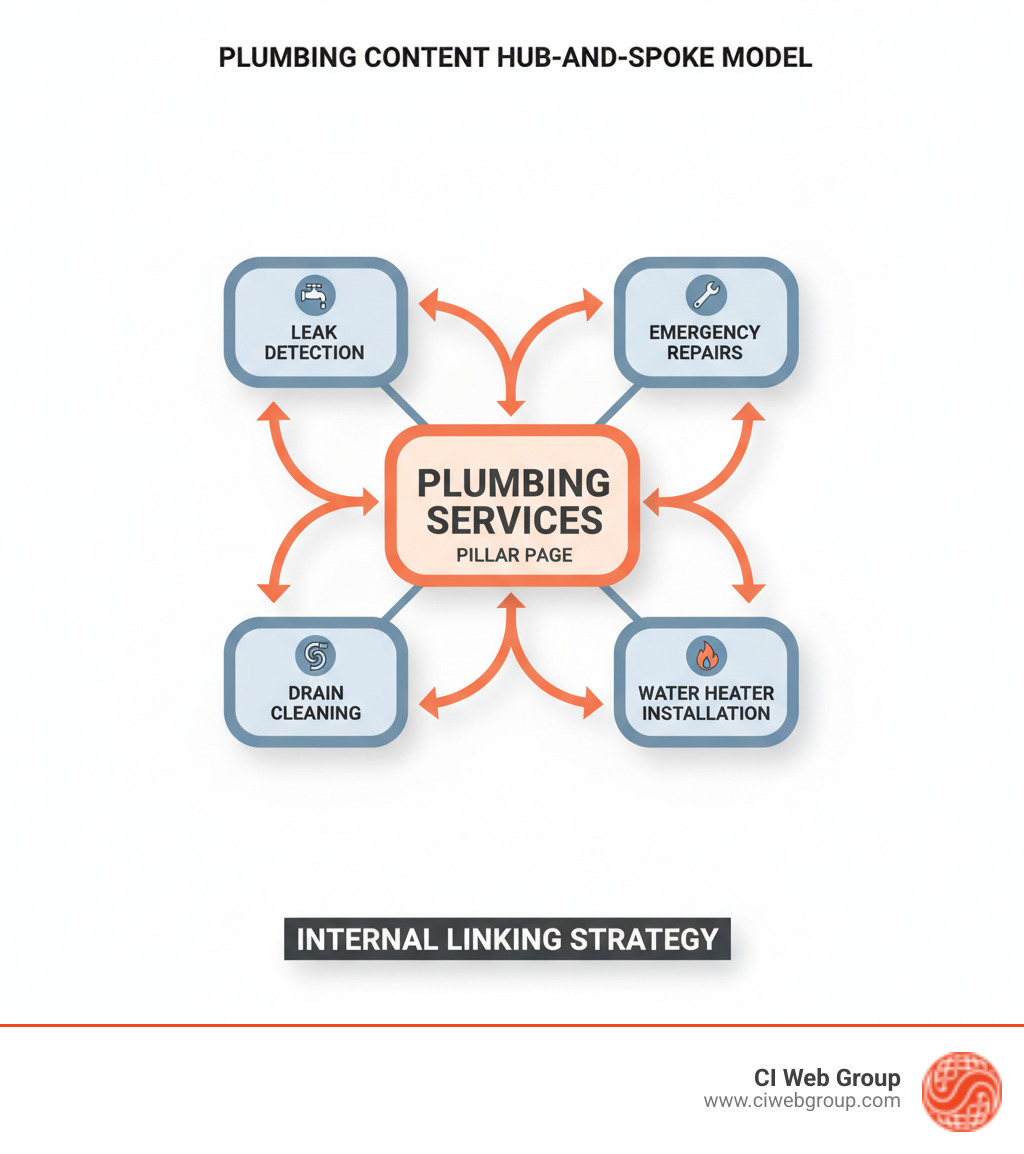
A content cluster is an SEO strategy that proves your expertise to Google. Instead of publishing random blog posts, you build organized groups of related content that all connect to a central hub.
Here's the structure:
This structure aligns with Google's E-E-A-T (Experience, Expertise, Authoritativeness, and Trustworthiness) principles, which directly influence rankings. The benefits include higher rankings, increased organic traffic, and a better user experience. Most importantly, it generates qualified leads. When a visitor finds a detailed answer to their urgent problem on your site, they are far more likely to call you for service. This strategy is what separates the 9% of websites that get traffic from Google from the 91% that remain invisible.
For a deeper look at how search engine optimization transforms plumbing businesses, check out our complete SEO for plumbers guide.
Plumbing customers have different needs. Some face emergencies, like a burst pipe at 2 AM, while others are planning a future project, like a water heater installation. A content cluster strategy serves both by answering questions at every stage.
Your content can provide immediate, trustworthy guidance to someone in a crisis, positioning you as the expert to call. It can also build trust with a homeowner who is researching options, making them confident in choosing your company when they're ready. With 2.9 million monthly searches for plumbing services and 46% of all Google searches being local, your customers are online right now. By consistently publishing valuable, interconnected content optimized for local searches, you increase your chances of appearing in the Google Maps 3-Pack—the top three local businesses shown in search results.
This is how you become the local authority: by anticipating customer questions, providing helpful answers, and earning their trust before they even pick up the phone.
To learn more about capturing those crucial local searches, visit our guide on local SEO for plumbers.
For more information on how we create content that actually generates leads, explore our content marketing services.

Building a content cluster is a step-by-step process that turns your website into a lead-generating machine. Whether you're wondering "Who can help me create a content cluster content calendar for my plumbing company?" or are ready to tackle it yourself, these steps provide a clear roadmap.
Start with what you do best. Your most profitable and expert services are the ideal candidates for pillar pages. For most plumbers, these include:
Focus on the services that define your business. If you specialize in trenchless sewer repair or commercial backflow prevention, build your authority there. A year-long plan based on your core services is crucial; without it, your competitors with a strategy will consistently outrank you.
Next, uncover what your customers are typing into Google. Keyword research helps you understand search intent—whether someone is looking for information (e.g., "how to fix a leaky faucet") or ready to hire (e.g., "emergency plumber near me").
Focus on long-tail keywords, which are longer, more specific phrases like "tankless water heater installation cost Houston." These searches have lower volume but higher intent. Combine them with local keywords (your city and service area) to target customers who can hire you.
Tools like Semrush, Ahrefs, and AnswerSocrates can uncover thousands of valuable search terms and customer questions, giving you a goldmine of content ideas. Your research will yield broad pillar page keywords ("Water Heater Services Texas") and more specific cluster content keywords ("signs of a slab leak," "hydro jetting vs. snaking").
For detailed guidance, check out our SEO for plumbers guide.
Now, organize your topics and keywords into the hub-and-spoke model. Your pillar page is the hub, and the cluster content pieces are the spokes. Start by outlining your comprehensive pillar pages (2,500+ words), then brainstorm all related sub-topics for your focused cluster articles.
This process, known as keyword clustering, helps search engines understand your expertise. Here's an example for a "Water Heater Services" cluster:
| Content Type | Topic/Title | Target Keywords |
|---|---|---|
| Pillar Page | Ultimate Guide to Water Heater Services in Southwest Texas | water heater repair, water heater installation, water heater replacement, water heater maintenance, hot water heater problems |
| Cluster Post 1 | How to Tell If Your Water Heater Needs Repair or Replacement | water heater not working, water heater leaking, no hot water, water heater age |
| Cluster Post 2 | Tankless Water Heaters vs. Traditional: What's Right for Your Home? | tankless water heater, traditional water heater, tankless water heater installation, tankless water heater benefits |
| Cluster Post 3 | Essential Water Heater Maintenance Tips for Longevity | water heater flushing, water heater anode rod, extend water heater life, water heater upkeep |
| Cluster Post 4 | Common Water Heater Problems and DIY Troubleshooting | water heater making noise, water heater pilot light, water heater too hot, water heater troubleshooting |
| Cluster Post 5 | Emergency Water Heater Repair Services in Houston, Texas | emergency water heater repair, urgent water heater service, 24/7 water heater help |
Each cluster post must link back to the pillar page, and the pillar should link out to the cluster posts. This interconnected structure proves your authority. Repeat this for each core service to build a comprehensive resource that dominates your local market.
If you need help with this strategic planning, our team specializes in this process. Explore our blogging services to see how we develop content that drives results.

So, you're ready to build a content strategy that fills your schedule. The big question is: who can help me create a content cluster content calendar for my plumbing company? The answer depends on your time, resources, and whether you prefer a hands-on approach or want to trust the experts.
Going the DIY route gives you full control and is the most cost-effective option. You know your business and customers best. However, the reality is that building an effective content strategy is a time-consuming, full-time job. The learning curve for SEO is steep, and without expertise, you risk creating content that never ranks—a fate that befalls 91% of all web pages.
If you're determined to go it alone, use tools to stay organized. Google Sheets is a great free option for your calendar. You can even download a free content calendar template to get started.
AI-powered platforms and SEO tools can significantly speed up the DIY process. They assist with topic generation, keyword research, and even creating content briefs. Tools like Semrush and AnswerSocrates can uncover thousands of questions your customers are asking.
However, human oversight is essential. AI is a powerful assistant, but it can't replace the human expertise needed to reflect your brand's voice, values, and the trust required in the plumbing business. Technology is a tool, not a replacement for strategy.
For more insights, read our article on artificial intelligence in online marketing.
As your business grows, you might consider hiring an in-house marketer or partnering with an agency.
An in-house team offers deep company knowledge and immediate availability. The downsides are significant costs (salaries, benefits, tools) and the difficulty of finding one person with comprehensive expertise in SEO, content, and local search.
Partnering with a specialized agency like CI Web Group provides access to an entire team of experts for less than the cost of one full-time employee. We bring industry-specific knowledge, understanding the seasonal trends and search behavior unique to plumbing customers in regions like Houston, Texas, the Pacific Northwest, and the Southwest.
When vetting an agency, be wary of the 70% of small businesses who are dissatisfied with their SEO provider. Look for an agency that offers complete transparency, ensures client asset ownership, and provides customized programs. Avoid those that:
At CI Web Group, we operate with no contracts and complete transparency, focusing on measurable business goals. For more guidance, explore these resources on questions to ask before hiring a marketing partner and the warning signs your SEO isn't working.
Once you've decided "Who can help me create a content cluster content calendar for my plumbing company?" and have a plan, the next step is execution. A well-organized calendar is the dispatch system for your marketing, ensuring nothing falls through the cracks.
Your content calendar should be more than a list of topics. For each piece of content, track:
Consistency is more important than volume, but businesses that publish 16+ posts per month see 3.5 times more traffic. Plan your content around seasonality—"Preventing Frozen Pipes" for winter in Texas and the Pacific Northwest, and "Summer AC Drain Line Maintenance" for the Southeast.
Focus on Key Performance Indicators (KPIs) that connect directly to revenue, not vanity metrics like page views. The metrics that matter are:
SEO is the highest quality source of leads for 60% of marketers, and tracking these KPIs proves its value for your business.
For a deeper dive into turning content into customers, see our guide on plumbing lead generation.
Content isn't a "publish and forget" task. Content decay is real, as information becomes outdated and competitors publish fresher content. Schedule regular refreshes for your pillar pages and top-performing cluster posts to keep them accurate and competitive.
Avoid these common mistakes:
If you're not seeing results, review the warning signs your SEO isn't working to diagnose the problem.
SEO is a marathon, not a sprint. While you're asking "Who can help me create a content cluster content calendar for my plumbing company?" with urgency, it's important to set realistic expectations. A content cluster strategy is a long-term investment.
You can typically expect to see meaningful improvements in traffic and rankings after at least 4-6 months of consistent publishing. The most significant results, like a substantial increase in qualified leads, often appear around the one-year mark. Consistency is the most critical factor for success.
SEO and PPC (Pay-Per-Click) are two different tools for generating leads.
A combined strategy is often most effective. SEO builds your foundation, while PPC captures immediate demand. Learn more in our guide on Google Ads for plumbers.
Most emergency plumbing searches happen on smartphones. Google knows this and prioritizes mobile-friendly sites in its rankings. If your website is difficult to use on a phone, you're not just frustrating potential customers—you're actively being penalized by Google.
Furthermore, website speed is critical. A slow-loading site, especially on mobile, will cause users in a panic to leave and call your competitor. Google's Core Web Vitals, which measure user experience and speed, are a significant ranking factor. You can use tools like Google PageSpeed Insights to check your site's performance. A fast, mobile-optimized website is essential to ensure your content strategy can successfully convert visitors into leads.
If you've been asking "Who can help me create a content cluster content calendar for my plumbing company?", you now know the answer lies in a strategic approach. Content clusters establish your authority, and a content calendar turns scattered efforts into a lead-generation machine, delivering sustainable growth that paid ads can't match.
However, you got into plumbing to solve problems for your customers, not to become an SEO expert. Trying to manage keyword research and content strategy while running your business is a recipe for burnout.
This is where CI Web Group comes in. We specialize in helping home service companies dominate their local markets. We understand the unique plumbing challenges and search trends in regions from Houston, Texas to the Pacific Northwest. We work exclusively in your industry.
We offer customized programs with complete transparency and no contracts—we earn your business every month by delivering results. You always own your website and content. Stop watching competitors get the calls that should be yours.
Dominate your local market with a proven plumbing marketing strategy. Let us build your blueprint for success so you can focus on what you do best.
Search our Blog
5 min read
The Complete Guide to Plumbing Website Design
Discover expert plumbing website design strategies that boost conversions, mobile performance, and local SEO for your plumbing business.
Read more

5 min read
5 Ways to Find a Reliable Plumber Fast
Discover plumbing website content strategies that help homeowners find a reliable plumber fast with mobile-friendly design and trust signals.
Read more

5 min read
The Definitive Guide to HVAC Vehicle Wraps
Discover how HVAC vehicle wraps boost brand visibility, generate leads, and build trust with professional fleet graphics that deliver lasting marketing results.
Read more

5 min read
Step-by-Step Guide to Reliable Pest Control Marketing
Discover how pest control marketing services can boost local visibility, generate leads, and drive recurring revenue with proven strategies for 2026.
Read more