Why Understanding Plumbing Market Trends Matters Now
Plumbing market trends are shifting faster than ever, and for any plumbing business, staying ahead of these changes is essential for survival and growth. The industry is being reshaped by technology, sustainability demands, workforce challenges, and new customer expectations. Understanding these trends helps you make smarter business decisions and position your company to capture more market share.
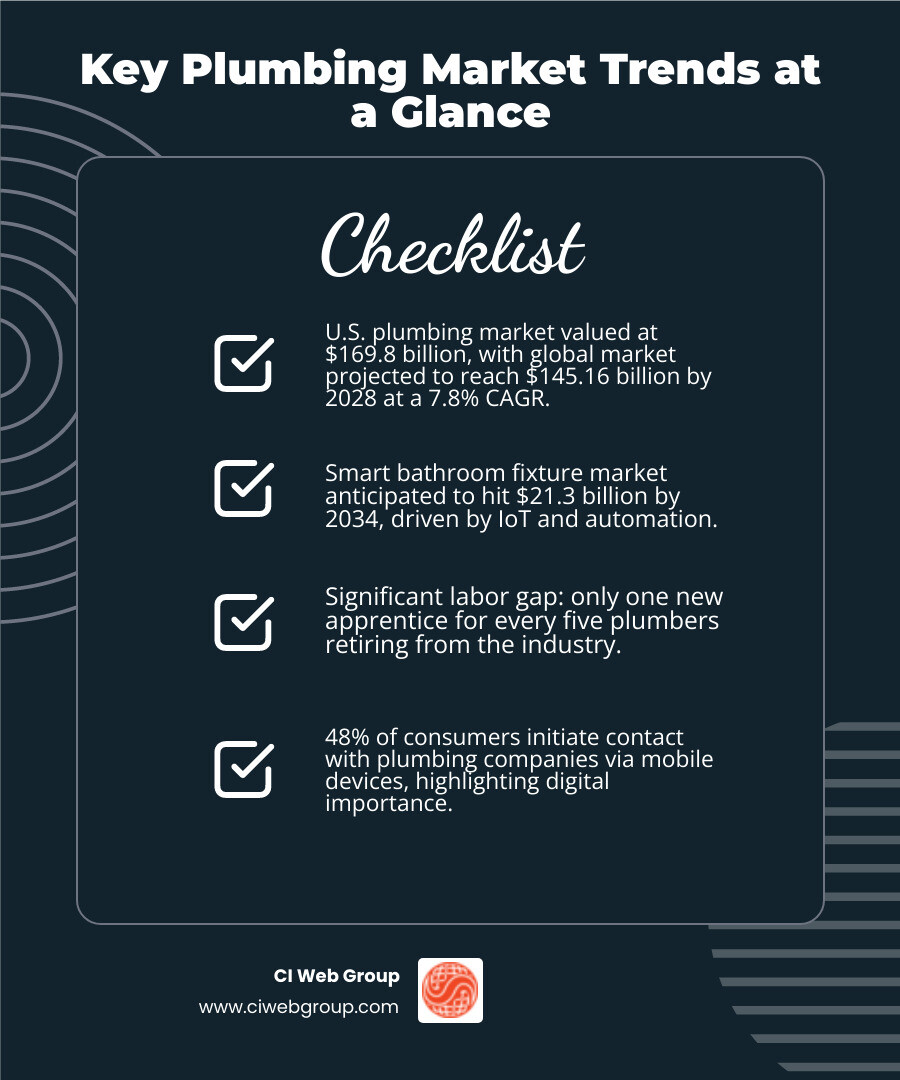
Key Plumbing Market Trends at a Glance:
- Market Size: The U.S. plumbing sector is valued at $169.8 billion and growing
- Global Growth: Projected to reach $145.16 billion by 2028 at a 7.8% CAGR
- Smart Technology: The smart bathroom fixture market will reach $21.3 billion by 2034
- Labor Opportunity: For every five plumbers retiring, only one enters apprenticeship programs
- Digital-First Customers: 48% of consumers first contact plumbing companies via mobile device
- Material Shifts: PVC usage grew from 51% to 70% between 2019 and 2023, while copper dropped from 19% to 5%
- Aging Infrastructure: The average U.S. home is now over 40 years old, driving repair and replacement demand
The plumbing industry is at an interesting crossroads. Demand is strong and stable—with 70-80% of services considered urgent, the industry is remarkably recession-resistant. However, how customers find plumbers and what they expect is changing rapidly. Smart fixtures, eco-friendly systems, and alternative materials are becoming mainstream, while high mortgage rates are keeping homeowners in aging houses longer, creating a sustained need for repairs and upgrades.
As Jennifer Bagley, I've spent years helping home service companies steer digital change. I've seen how understanding plumbing market trends separates thriving businesses from struggling ones. The companies winning today aren't just good at plumbing—they're adapting quickly to industry changes and meeting customers in the modern buyer's journey.
Related content about plumbing market trends:
The Big Picture: Market Growth and Core Drivers

The numbers behind current plumbing market trends tell a compelling story. The industry isn't just steady; it's growing in ways that create real opportunities for businesses willing to adapt. The global market for plumbing fixtures and fittings grew to $98.16 billion in 2023 and is on track to continue its momentum. The global market is projected to grow to $145.16 billion by 2028 at a 7.8% compound annual growth rate.
In the United States, the plumbing sector is a powerhouse. The U.S. plumbing industry is worth over $121 billion, with some estimates placing the total market value at $169.8 billion. A primary driver of this demand is our aging infrastructure. Aging homes are a key driver of plumbing work, as the average U.S. home is now over 40 years old. This means four decades of wear on pipes, fixtures, and water heaters, often requiring complete system upgrades to prevent failures and meet modern standards.
Why the Plumbing Market Continues to Expand
Several forces are keeping the plumbing market on an upward trajectory:
Residential construction remains a consistent driver, with the global residential plumbing market estimated to grow by $26.20 billion from 2024 to 2028. Every new home requires a complete plumbing system.
Commercial development is expanding in sectors like data centers, healthcare, and education, all requiring sophisticated plumbing systems and creating opportunities for specialized businesses.
Water-efficiency regulations are tightening nationwide due to water scarcity concerns. Mandates for low-flow fixtures and efficient water heaters are becoming standard, creating ongoing demand for retrofits and upgrades.
Health and hygiene awareness has increased, driving investment in advanced water filtration, touchless fixtures, and improved drainage designs. These are now seen as necessities, not luxuries.
Urbanization drives infrastructure development in growing cities. Expanding urban centers need new and updated water systems, requiring skilled plumbers. Understanding these growth patterns is crucial for your home service business.
The "Lock-In Effect" and Remodeling Demand
High mortgage rates have created a "lock-in effect," where homeowners with low rates are staying put instead of moving. This presents a unique opportunity for plumbers. When people don't move, they invest in the homes they have. They're not just patching leaks; they're undertaking complete bathroom remodels, upgrading to tankless water heaters, and replacing aging supply lines.
This shift means homeowners are treating their properties as long-term investments, leading to more comprehensive projects with higher ticket values. The remodeling boom is especially strong in areas with older housing stock. Whether you serve homeowners in Houston, the Pacific Northwest, Southeast, or Southwest, your customers are increasingly looking for upgrade and replacement services. Plumbing lead generation strategies that highlight your expertise in system upgrades can help you capture this growing market segment.
The bottom line is that plumbing market trends point to sustained growth. For businesses willing to adapt their services and marketing, the opportunities are substantial.
The Tech & Sustainability Wave: Smart, Efficient, and Green Plumbing

Technology and sustainability are now essential plumbing market trends that define success. Customers expect their plumbing systems to be smarter, more efficient, and environmentally responsible. This shift is driven by homeowners' desire to lower utility bills, prevent costly damage, and align with sustainability values. This wave of innovation creates tremendous opportunities for plumbing businesses that offer modern solutions. AI Lead Generation for Home Services explores how technology is changing how we connect with these customers.
Smart Plumbing Goes Mainstream
Smart plumbing has moved from luxury to mainstream expectation, with the smart bathroom fixture market projected to reach $21.3 billion by 2034. These technologies solve real problems and offer genuine convenience.
Smart toilets are a key trend, with a market projected to hit $12.7 billion by 2025. Offering features like heated seats, auto-flushing, and health monitoring, they appeal to the 43.1% of homeowners interested in upgrading.
Leak detection sensors are crucial for preventing water damage. They monitor water flow, send alerts for leaks, and can even automatically shut off water, saving homeowners thousands.
Wi-Fi enabled water heaters offer remote control and maintenance alerts via smartphone. They learn usage patterns to optimize heating and save energy.
Voice-activated faucets provide hands-free operation, reducing water waste and improving hygiene. They integrate with smart home platforms and are popular in kitchens.
IoT integration enables real-time monitoring of water quality and pressure, allowing for proactive maintenance services. This shift builds stronger customer relationships and recurring revenue. Our Plumber AI Marketing Guide 2025 shows how to market these solutions.
Eco-Conscious is the New Standard
Sustainability is now a mainstream expectation. Consumers actively seek eco-friendly plumbing options to reduce their carbon footprint and lower utility bills.
WaterSense certified fixtures are an easy entry into sustainable plumbing. These EPA-certified products use less water without sacrificing performance, saving thousands of gallons per household annually.
Low-flow toilets now offer powerful flushes using as little as 1.28 gallons, compared to 3.5-7 gallons in older models, leading to significant water savings.
Greywater recycling systems are gaining traction in drought-prone regions. They capture, treat, and reuse water from sinks and showers for irrigation or toilets, dramatically reducing household water consumption.
Tankless water heaters provide energy efficiency and convenience by heating water on demand. This eliminates standby energy loss and ensures an endless supply of hot water.
Drought management solutions like rainwater harvesting are becoming popular. They collect and store rainwater for non-potable uses, easing pressure on municipal water supplies.
Solar water heaters use solar energy to heat water, offering significant savings. The U.S. solar water heater market is growing, and businesses that install these systems are seen as sustainability partners.
Embracing these eco-conscious technologies is smart business. Homeowners will invest in solutions that align with their values, and positioning your company as an expert sets you apart.
Evolving Methods and Materials: A Look at the Latest Plumbing Market Trends

The plumbing industry is changing not just in what we install, but how we install it. Sticking to old methods means missing opportunities to better serve customers. The plumbing market trends around materials and methods are creating real advantages for businesses that adapt.
The Shift in Piping Materials
On modern job sites, copper is increasingly rare. While a reliable material, its economics and practicality have shifted. Data shows PVC use growing to 70% of projects in 2023, up from 51% in 2019, while copper use fell from 19% to just 5%.
PEX and PVC adoption is driven by more than cost. These materials resist corrosion and scale, handle temperature extremes well, and can outlast copper, offering advantages for both plumbers and homeowners.
The ease of installation is a major benefit, especially with labor shortages. Flexible PEX and lightweight PVC allow for faster work. When you can complete a repipe in two days instead of four, everyone wins—your crew, your bottom line, and the homeowner.
The durability and cost-effectiveness of PEX and PVC make them attractive for whole-house repiping and small repairs. Knowing when to recommend each material is now essential for modern plumbers. Our Services reflect these material innovations.
Innovative Installation and Repair Techniques
Installation and repair methods have also evolved. Destructive "dig and replace" techniques are being replaced by methods that save homeowners time and protect their property.
Trenchless sewer repair is a transformative, minimally invasive solution. Using cured-in-place-pipe (CIPP) technology, a new, seamless pipe is created inside the old one without destructive excavation. This is a major selling point for homeowners who want to protect their landscaping and driveways, and demand is growing.
Modular plumbing systems and prefabrication are changing larger projects, especially in commercial developments. Entire plumbing assemblies are built off-site in a factory, then installed as complete units. The prefabrication benefits include better quality control, faster installation, and reduced labor and waste—a significant advantage given the skilled labor shortage.
These evolving techniques meet modern customer expectations for repairs that don't destroy their property and installations that happen quickly. The businesses thriving in 2025 are the ones that have acceptd these innovations.
The Business Side: Navigating Challenges and Seizing Opportunities

Understanding plumbing market trends is crucial, but running a successful business requires navigating challenges like workforce shortages, regulations, and digital marketing. Getting the business side right has never been more important.
Tackling the Skilled Labor Shortage
The skilled labor shortage is one of the industry's biggest challenges. With a ratio of five retiring plumbers for every one new apprentice, the workforce gap is widening. This shortage leads to longer customer wait times and strains businesses. However, it also creates opportunities for well-organized, efficient companies to stand out.
Demand for plumbers is high, and the median salary for plumbers exceeds $60,000. Despite efforts toward rebuilding the construction trades workforce, attracting new talent remains a challenge. For your business, this means that becoming a great place to work, investing in training, and operating efficiently will allow you to capture market share from competitors who can't keep up.
Staying Ahead of Regulatory Curves and other plumbing market trends
Plumbing regulations constantly evolve to address water quality, public health, and sustainability. Compliance is essential for protecting communities and building a trustworthy reputation.
The EPA's Lead and Copper Rule Improvements (LCRI) are a significant update. Since September 2023, all plumbing products must have "lead free" certification to protect drinking water, and compliance is mandatory.
State-level codes add more complexity. For example, Texas plumbers are regulated by The Texas Department of Licensing and Regulation, and other states have their own unique requirements for water conservation and backflow prevention.
Water-efficiency regulations are tightening nationwide, especially in drought-prone areas, mandating more sustainable practices. Health and safety standards for things like backflow prevention are also continuously updated. Staying current with these changes positions your business as a trusted expert for safe, compliant installations.
Winning Online: Why Digital Marketing is Non-Negotiable
If your plumbing business isn't visible online, you're invisible to most customers. The way people find plumbers has fundamentally changed. Customers search for plumbers on their phones; in fact, 48% of consumers first contact companies via a mobile device, and 69% of smartphone users expect a seamless mobile website. A poor mobile experience means losing customers instantly.
Online reputation is also critical. 97% of consumers read online reviews, and 88% trust them as much as personal recommendations. Your online reviews are your digital word-of-mouth.
Search Engine Optimization (SEO) is essential for being found online. If you don't appear on the first page of Google for searches like "emergency plumber" in your area (Houston, Pacific Northwest, etc.), you're losing business. Our SEO for Plumbers Complete Guide explains how to rank for these critical searches.
Local search dominance is critical, as over 70% of clicks go to the Google Maps 3-Pack and organic results. Optimizing your Google Business Profile with accurate info, photos, and reviews is essential for attracting nearby customers. Our Plumbing Google My Business guide can help.
A comprehensive digital marketing strategy is the foundation for growth. The winning businesses are those that customers can easily find, trust, and contact online. Our Plumbing Business Marketing Guide helps you build that foundation.
Frequently Asked Questions about Plumbing Industry Trends
What is the biggest opportunity for plumbing businesses in 2025?
The biggest opportunity is meeting homeowner demand for smart, sustainable solutions. Specializing in high-value services like smart leak detection, whole-home water filtration, and trenchless sewer repair sets your business apart. These offerings address real customer concerns about convenience, safety, and sustainability, allowing you to provide more value than competitors focused on basic repairs. When you can offer integrated, eco-friendly solutions that align with plumbing market trends, you're not just fixing pipes—you're providing genuine value.
How is the labor shortage affecting the plumbing industry?
The labor shortage creates hiring challenges but also a major opportunity. With fewer skilled plumbers available, efficient and well-marketed companies can capture more market share. Customers who can't get an appointment with one company will gladly turn to another that's available and professional. This environment means skilled plumbers can command higher value. It's a chance to differentiate your business and grow while others struggle to keep up.
Why is a strong online presence so critical for plumbers now?
Because the majority of customers begin their search for a plumber on a mobile device. Before they call, they're Googling "emergency plumber near me" and checking your online reviews. If your business doesn't show up in those search results with a professional website and positive feedback, you might as well not exist.
A strong digital footprint is essential for lead generation. Your website must load quickly on mobile, your Google Business Profile needs to be accurate, and your online reputation must reflect quality service. Without these elements, you're handing customers to your competitors. The businesses winning today are the ones customers can find easily online, trust based on reviews, and contact with a single tap. That's why we focus on helping plumbing businesses dominate their local market digitally. Learn how our data-driven strategies can help you dominate your local market.
For a deeper dive into building your online presence, check out our Plumbing Business Marketing Guide.
Conclusion
The plumbing market trends for 2025 reveal a stable yet evolving industry full of opportunity. Market growth is strong, driven by aging homes, the lock-in effect, and homeowner demand for repairs and upgrades. At the same time, smart technology and sustainability are fundamentally changing what customers expect from their plumbing systems.
The shift to PEX and PVC, the rise of trenchless repair, and the explosion of smart fixtures represent the new baseline for modern plumbing. Meanwhile, the skilled labor shortage, while challenging, creates an opportunity for efficient, well-marketed businesses to capture more market share.
What ties all these plumbing market trends together is the digital revolution. With 48% of consumers making first contact via mobile and 97% reading online reviews, your digital presence is as important as your technical skills. You can be the best plumber in Houston, the Pacific Northwest, Southeast, or Southwest, but if customers can't find you online, you're invisible.
Future-proofing your plumbing business means embracing technology in the field and online. It means understanding that homeowners want smart, eco-friendly options and a seamless digital experience. It means positioning yourself as a trusted advisor who stays ahead of industry changes.
At CI Web Group, we understand these plumbing market trends because we live the digital side of the home services industry. We help plumbing businesses transform their online presence, dominate local search, and turn visitors into loyal customers. Our approach is built on transparency, data-driven strategies, and the belief that you should own every asset we create for you.
The plumbing industry's future is bright for those ready to evolve. We're here to help you steer this exciting landscape.
Learn how our data-driven strategies can help you dominate your local market